
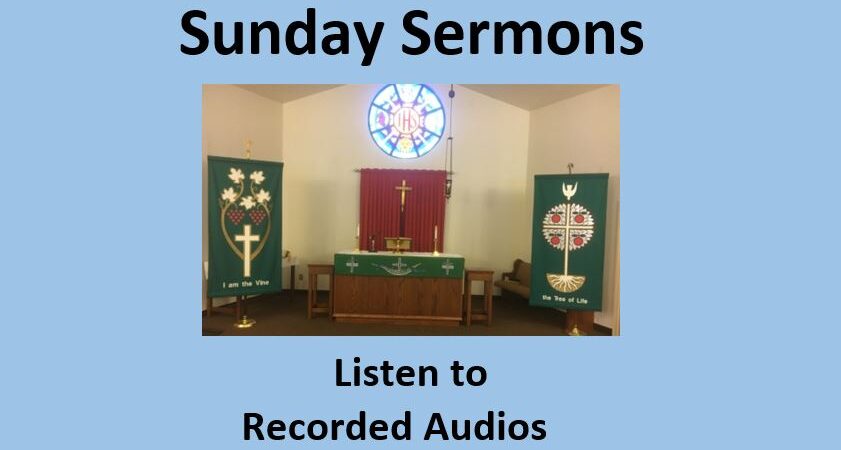
Sunday Sermons – Audio
Sunday Sermon – June 14, 2026
Gospel: Matthew 9:35-38, Matthew 10:1-8
The Harvest Is Plentiful, the Laborers Few 35 And Jesus went throughout all the cities and villages, teaching in their synagogues and proclaiming the gospel of the kingdom and healing every disease and every affliction. 36 When he saw the crowds, he had compassion for them, because they were harassed and helpless, like sheep without a shepherd. 37 Then he said to his disciples, “The harvest is plentiful, but the laborers are few; 38 therefore pray earnestly to the Lord of the harvest to send out laborers into his harvest.” The Twelve Apostles 10 1And he called to him his twelve disciples and gave them authority over unclean spirits, to cast them out, and to heal every disease and every affliction. 2 The names of the twelve apostles are these: first, Simon, who is called Peter, and Andrew his brother; James the son of Zebedee, and John his brother; 3 Philip and Bartholomew; Thomas and Matthew the tax collector; James the son of Alphaeus, and Thaddaeus; 4 Simon the Zealot, and Judas Iscariot, who betrayed him. Jesus Sends Out the Twelve Apostles 5 These twelve Jesus sent out, instructing them, “Go nowhere among the Gentiles and enter no town of the Samaritans, 6 but go rather to the lost sheep of the house of Israel. 7 And proclaim as you go, saying, The kingdom of heaven is at hand.’ 8 Heal the sick, raise the dead, cleanse lepers, cast out demons. You received without paying; give without pay.
Sunday Sermon Audio: Presented by Intern Pastor Meloni Puishes
Sunday Sermon Summary
Subject: The Sounds of Summer
Key Points
- Creation Proclaims God’s Glory
- The sermon opens with reflections on camping and listening to birds, crickets, frogs, and owls.
- All creation praises God and points beyond itself to its Creator.
- Christians are encouraged to slow down and notice God’s witness in creation.
- Jesus Hears the Burdens of People
- Beneath the beauty of creation are people carrying grief, loneliness, fear, guilt, illness, and worry.
- Jesus saw the crowds as “sheep without a shepherd” and was moved with compassion.
- He looked beyond the crowd and saw individuals with real needs.
- The Meaning of Christ’s Compassion
- The Greek word for compassion describes a deep, gut-level concern.
- Jesus did not merely feel sorry for people; He felt their suffering deeply.
- His compassion always led to action—healing, teaching, feeding, forgiving, and restoring.
- Learning to See People as Jesus Sees Them
- Jesus teaches His disciples to truly see others.
- People are not interruptions, projects, or problems; they are beloved children of God.
- The first task of a harvest worker is learning to see people through Christ’s eyes.
- We Were Once the Harvest
- Before believers were sent to serve, they themselves were lost sheep in need of a Savior.
- Christ came seeking us while we were still weak and sinful.
- Remembering God’s grace toward us creates humility and compassion toward others.
- The Harvest Is Plentiful
- Jesus tells His disciples to pray for workers because many people need hope, forgiveness, and encouragement.
- The problem is not a lack of people needing Christ, but a shortage of workers willing to serve.
- The Answer to the Prayer
- After telling the disciples to pray for workers, Jesus immediately sends them out.
- The answer to the prayer was the very people who prayed it.
- God often answers prayers for workers by calling those already sitting in the pews.
- God Uses Imperfect People
- The disciples were ordinary and flawed people—fishermen, a tax collector, a doubter, and even a betrayer.
- God sends people not because they are qualified, but because Christ is qualified.
- Christians serve in confidence because they know the One who has all the answers.
- Summer Opportunities for Mercy
- Everyday encounters—with neighbors, travelers, friends, and strangers—are opportunities to show Christ’s love.
- Christians are called to listen, encourage, show kindness, and share the hope found in Jesus.
- Witnessing often begins with simple acts of compassion.
- Freely Received, Freely Give
- Believers do not create grace, forgiveness, or salvation; Christ does that.
- Christians simply share the mercy, compassion, forgiveness, and Good News they have already received.
- The Church joins creation in proclaiming that the Kingdom of Heaven is near and that Christ has come for His sheep.
Sermon Takeaway Jesus sees people with deep compassion and calls His followers to do the same. Having first received God’s grace ourselves, we are sent into the world as workers in His harvest—sharing mercy, encouragement, and the Good News of Christ with those around us.
————————————————————————————
Sunday Sermon – May 31, 2026
Gospel: Matthew 28:16-20 The Great Commission 16 Now the eleven disciples went to Galilee, to the mountain to which Jesus had directed them. 17 And when they saw him they worshiped him, but some doubted. 18 And Jesus came and said to them, “All authority in heaven and on earth has been given to me. 19 Go therefore and make disciples of all nations, baptizing them in the name of the Father and of the Son and of the Holy Spirit, 20 teaching them to observe all that I have commanded you. And behold, I am with you always, to the end of the age.”
Sunday Sermon Audio: Presented by Intern Pastor Meloni Puishes
Sunday Sermon Summary
Subject: The God Who Carries What We Cannot
Main Scripture
- Focus on the Great Commission from the Gospel of Matthew: Jesus commands His disciples to:
- Go and make disciples of all nations.
- Baptize in the name of the Father, Son, and Holy Spirit.
- Teach obedience to Christ’s commands.
- Trust Christ’s promise: “I am with you always.”
Central Theme
- The sermon shifts attention away from simply the word “Go” and focuses instead on:
- Christ’s authority: “All authority in heaven and on earth has been given to me.”
- Christ’s presence: “I am with you always.”
Burdens We Were Never Meant to Carry
- People often carry responsibilities that belong to God, including:
- Trying to fix other people.
- Controlling outcomes.
- Forcing growth or change.
- Holding everything together.
- Constant worry about the future.
- Key reminder:
- Jesus never asked believers to carry the whole weight of the world—He carries it.
The Condition of the Disciples
- The disciples were not fearless or perfectly confident.
- Matthew describes them as worshiping Jesus while some still doubted or hesitated.
- Jesus commissions them anyway because:
- The mission depends on Christ’s authority, not human strength.
Personal Illustration: The Pecan Tree
- The pastor reflected on a pecan tree that appeared dead during winter.
- After observing it in spring, signs of life became visible:
- Green growth.
- Pollen/fringe growth necessary for future fruit.
Spiritual Lesson from the Tree
- Things that appear dead are not always dead.
- Sometimes life is present but hidden:
- Conserving strength.
- Waiting for another season.
- Growing beneath the surface.
- Application:
- We often mistake “fruit-bearing seasons” for dead seasons in:
- Faith
- Family
- Relationships
- Work
- Business
- Church life
- We often mistake “fruit-bearing seasons” for dead seasons in:
Important Spiritual Insight
- Roots grow underground long before fruit appears.
- God may already be working in unseen ways.
- Sometimes growth is happening before we can recognize it.
Perspective Shift
- The tree did not need human worry to survive winter.
- It did not need someone standing over it demanding growth.
- Likewise:
- God’s work does not depend on human anxiety.
- What often needs changing is our perspective, not the situation.
Application to the Church
- Jesus reminds His disciples:
- He carries the mission.
- The church belongs to Him.
- Salvation and changed hearts belong to God.
- Believers are called to:
- Be faithful.
- Go and tell.
- Baptize.
- Teach.
- Love others.
- But:
- Growth belongs to God.
- The future belongs to God.
- The church belongs to God.
Holy Trinity Sunday Emphasis
- Christians are baptized into one name:
- The Father
- The Son
- The Holy Spirit
- Roles emphasized:
- The Father creates and sends.
- The Son redeems and reigns.
- The Holy Spirit creates faith, sanctifies, and gives life.
Final Encouragement
- What looks unproductive or lifeless may simply be preparing for a future season.
- God is still working even when His work is unseen.
- The future is safer in God’s hands than ours.
- Christ’s promises remain:
- He has all authority.
- He is always with His people.
- He is carrying what we cannot.
Closing Message
- Trust God during seasons that seem barren or uncertain.
- Release burdens that belong to Christ.
- Have confidence that God is still bringing life where we cannot yet see it.
__________________________________________________________________________________________________
Sunday Sermon – May 24, 2026, May 17, 2026
Sermon did not get recorded.
_________________________________________________________________________________________________
Sunday Sermon – May 10, 2026
Jesus Promises the Holy Spirit 15 “If you love me, you will keep my commandments. 16 And I will ask the Father, and he will give you another Helper, to be with you forever, 17 even the Spirit of truth, whom the world cannot receive, because it neither sees him nor knows him. You know him, for he dwells with you and will be in you. 18 “I will not leave you as orphans; I will come to you. 19 Yet a little while and the world will see me no more, but you will see me. Because I live, you also will live. 20 In that day you will know that I am in my Father, and you in me, and I in you. 21 Whoever has my commandments and keeps them, he it is who loves me. And he who loves me will be loved by my Father, and I will love him and manifest myself to him.”
Sunday Sermon Audio: Presented by Intern Pastor Meloni Puishes
Sunday Sermon Summary
Subject: Because Not “If”
- “If you love Me, keep My commandments” is not a threat
- The sermon begins by addressing how many Christians hear Jesus’ words as a test or condition.
- The pastor explains that constantly trying to “prove” love for Jesus leads to fear, exhaustion, and self-doubt.
- Greek insight changes the meaning
- The pastor examines the original Greek text.
- The phrase is presented less as “If…then…” and more as a description of a living relationship:
- Loving Christ and keeping His commandments naturally belong together.
- The “coin” analogy
- Love and obedience are compared to two sides of a coin.
- One side cannot exist without the other.
- Christian life is not:
- Love without obedience
- Obedience without love
- Instead, it is one unified life shaped by Christ.
- Two common spiritual errors
- Some want:
- Grace without transformation
- Comfort without surrender
- Others want:
- Rules and control without mercy or gentleness
- Jesus rejects both extremes because love and obedience belong together.
- Some want:
- God Himself holds believers together
- Human beings cannot perfectly unite love and obedience on their own.
- Jesus responds by promising the Holy Spirit.
- The sermon highlights the work of the Trinity:
- The Son asks
- The Father gives
- The Holy Spirit comes
- This is one God acting together in love for His people.
- Jesus has always been the Comforter
- Jesus walked with, taught, corrected, protected, and loved the disciples.
- Now He prepares them for His departure.
- The disciples fear abandonment as their world seems to collapse.
- Fear makes people act like orphans
- When afraid, people:
- Cling to control
- Resist change
- Fight over security and territory
- Jesus answers this fear with the promise:
- “I will not leave you as orphans.”
- When afraid, people:
- The Holy Spirit abides permanently
- The Spirit is not an occasional visitor.
- The Spirit dwells within believers continuously.
- Jesus’ departure is not abandonment but a deeper presence of God with His people.
- The coin also symbolizes redemption
- The pastor expands the coin analogy:
- Coins purchase things.
- Believers were “bought with a price”:
- Not silver or gold
- But the blood of Christ.
- The pastor expands the coin analogy:
- Sin cracked the coin
- Sin separated what God joined together:
- Love from obedience
- Faith from life
- Humanity became fearful, self-focused, and broken.
- Sin separated what God joined together:
- Christ redeems what was broken
- Jesus did not merely give better rules.
- He redeemed humanity through the cross.
- Christ “spent Himself” for the life of the world.
- Resurrection restores life
- “Because I live, you also shall live.”
- The resurrection brings real and living restoration.
- What was broken begins to hold together again through Christ.
- The Christian life is abiding in God
- Jesus’ promise:
- “I am in the Father, and you in Me, and I in you.”
- Christianity is not merely:
- Knowing facts
- Trying harder
- It is living within the life and love of God Himself.
- Jesus’ promise:
- Obedience flows from redemption, not fear
- Jesus is not demanding payment from condemned people.
- The debt has already been paid at the cross.
- Believers obey because they are redeemed, loved, and indwelt by the Spirit.
- Closing message
- The Christian life is:
- Love and keeping
- Faith and life
- Christ in believers and believers in Christ
- The Christian life is:
- The sermon concludes with the image of the two-sided coin forever held together in the hands of God.
________________________________________________________________________________________________________
Sunday Sermon – May 03, 2026
Gospel: John 14:1-14 I Am the Way, and the Truth, and the Life 14 “Let not your hearts be troubled. Believe in God; believe also in me. 2 In my Father’s house are many rooms. If it were not so, would I have told you that I go to prepare a place for you? 3 And if I go and prepare a place for you, I will come again and will take you to myself, that where I am you may be also. 4 And you know the way to where I am going.” 5 Thomas said to him, “Lord, we do not know where you are going. How can we know the way?” 6 Jesus said to him, “I am the way, and the truth, and the life. No one comes to the Father except through me. 7 If you had known me, you would have known my Father also. From now on you do know him and have seen him.” 8 Philip said to him, “Lord, show us the Father, and it is enough for us.” 9 Jesus said to him, “Have I been with you so long, and you still do not know me, Philip? Whoever has seen me has seen the Father. How can you say, ‘Show us the Father’? 10 Do you not believe that I am in the Father and the Father is in me? The words that I say to you I do not speak on my own authority, but the Father who dwells in me does his works. 11 Believe me that I am in the Father and the Father is in me, or else believe on account of the works themselves. 12 “Truly, truly, I say to you, whoever believes in me will also do the works that I do; and greater works than these will he do, because I am going to the Father. 13 Whatever you ask in my name, this I will do, that the Father may be glorified in the Son. 14 If you ask me anything in my name, I will do it.
Sunday Sermon Audio: Presented by Dr. Richard Brunk, Jr.
Sunday Sermon Summary
Subject: I am the Way
1. The Nature of “Good News”
- People generally like good news—but often it comes with added responsibility or expectations.
- Examples:
- Positive doctor visit followed by lifestyle changes.
- Praise at work leading to more duties.
- Volunteer appreciation turning into more commitments.
- Common sentiment: “No good deed goes unpunished.”
2. Success Brings More Responsibility
- In Acts 6, the early church grows rapidly.
- Growth requires organization, delegation, and more workers.
- Lesson: Success in ministry (and life) often leads to increased responsibility, not ease.
3. The Story of Stephen
- Stephen’s ministry was highly successful—many were drawn to the faith.
- Despite this, he faced strong opposition and was ultimately killed.
- Key point:
- Even genuine, faithful work can lead to hardship and rejection.
- The “good news” he preached was rejected by those who should have accepted it.
4. Preaching vs. “Meddling”
- Distinction introduced:
- Preaching: Proclaiming truth.
- Meddling: Confronting uncomfortable or challenging issues.
- Stephen is presented as an example of someone whose preaching was perceived as meddling.
- Faithfulness to truth can provoke resistance.
5. The “On the One Hand / On the Other Hand” Tension (1 Peter)
- Christian life contains constant contrasts:
- Desire spiritual truth ↔ Risk of rejection.
- Being chosen by God ↔ Temptation to fall away.
- Living in faith ↔ Pressure from the world.
- The good news is always present—but so is opposition.
6. Human Tendency to Doubt Good News (John 14)
- The Gospel promises:
- Peace
- Salvation
- Eternal life in Christ
- Yet even disciples struggled with:
- Confusion
- Fear
- Doubt
- Question raised: Why do people resist or obscure the good news?
7. Choosing Defeat Over Victory
- Illustration: “Snatching defeat from the jaws of victory.”
- People often:
- Know the truth
- Yet choose doubt, fear, or negativity instead
8. The “DOOM” vs. “Do It Right” Mindset
- Two contrasting attitudes:
- DOOM: “Didn’t Organize, Only Moved” (avoiding real change)
- Do it right, do it now” (intentional, faithful action)
- People tend to default to avoidance rather than meaningful action.
9. Negative Mindset Example – Eeyore
- Many live like Eeyore (from Winnie the Pooh):
- Pessimistic
- Isolated
- Focused on problems
- Even with good news, people may respond with negativity or self-pity.
10. Final Encouragement and Promise
- Core message:
- Christ is risen.
- Believers have eternal life.
- Jesus’ promise:
- Those who believe will do great works.
- God responds to prayers made in His name.
- Call to action:
- Embrace the good news fully.
- Don’t let doubt, fear, or negativity overshadow it.
Closing Thought
- The good news of Christ is real and powerful—but it requires faith to accept it without letting “the other hand” (doubt, fear, resistance) take over.
__________________________________________________________________________________
Sunday Sermon – April 26, 2026
Gospel: John 10:1-10 I Am the Good Shepherd 10 “Truly, truly, I say to you, he who does not enter the sheepfold by the door but climbs in by another way, that man is a thief and a robber. 2 But he who enters by the door is the shepherd of the sheep. 3 To him the gatekeeper opens. The sheep hear his voice, and he calls his own sheep by name and leads them out. 4 When he has brought out all his own, he goes before them, and the sheep follow him, for they know his voice. 5 A stranger they will not follow, but they will flee from him, for they do not know the voice of strangers.” 6 This figure of speech Jesus used with them, but they did not understand what he was saying to them. 7 So Jesus again said to them, “Truly, truly, I say to you, I am the door of the sheep. 8 All who came before me are thieves and robbers, but the sheep did not listen to them. 9 I am the door. If anyone enters by me, he will be saved and will go in and out and find pasture. 10 The thief comes only to steal and kill and destroy. I came that they may have life and have it abundantly.
Sunday Sermon Audio: Presented by Intern Pastor Meloni Puishes
Sunday Sermon Summary
Subject: A Life to Live
1. Introduction: Familiar Yet Powerful
- Psalm 23 is one of the most well-known and memorized passages in Scripture.
- Its familiarity can cause people to overlook its depth and meaning.
- The sermon’s focus:
- View the Psalm outwardly, not just personally.
- Use it for evangelism and discipleship, especially with unbelievers or struggling believers.
2. “The Lord is My Shepherd” – Universal Imagery
- Shepherd imagery represents guidance, protection, and care.
- This metaphor was understood across ancient cultures (not just Israel).
- David begins with a relatable concept for all people.
3. “I Lack Nothing” – God’s Provision
- God consistently provides throughout Scripture:
- Garden for Adam and Eve
- Clothing after the fall
- Provision for Abraham (ram)
- Manna and water in the wilderness
- Understanding “lack nothing” requires spiritual maturity.
- Key truth: God provides what we need, not always what we want.
4. Green Pastures & Still Waters – Spiritual Rest
- Sheep depend entirely on the shepherd for nourishment.
- Humans similarly struggle to find true spiritual satisfaction.
- Looking away from Christ leads to anxiety and unrest.
- Returning to Him brings peace and restoration, though sometimes gradually.
5. “Paths of Righteousness” – Living for God’s Name
- Our behavior reflects on God’s reputation.
- God’s concern is not insecurity, but how others come to know Him through us.
- Modern application:
- Actions often speak louder than words.
- Believers represent God to the world.
6. “Valley of the Shadow of Death” – Presence in Trials
- Valleys represent fear, confusion, and hardship.
- God does not promise avoidance of difficulty, but presence within it.
- Believers are called to:
- Stay close to the Shepherd
- Walk together in community
- Key truth: God’s presence overcomes fear.
7. “Table Before Enemies” – Provision in a Broken World
- God provides even in the presence of opposition.
- Represents grace, sustenance, and communion (Christ’s body and blood).
- Blessing is not dependent on circumstances.
8. “Anointed Head & Overflowing Cup” – Identity and Abundance
- Anointing signifies being set apart (priests, kings).
- Points to deeper meaning:
- Connection to “Messiah” / “Christ” (the Anointed One)
- Overflowing cup symbolizes:
- Abundant life in Christ
- God’s hospitality and generosity
9. “Goodness and Mercy” – Assurance
- Confidence that God’s care is constant and ongoing.
- Reinforces trust in God’s lifelong faithfulness.
10. “Dwell in the House of the Lord Forever” – Eternal Promise
- All cultures longed to remain with their god.
- Some even created statues to symbolize permanent presence.
- Biblical distinction:
- Eternal life with God is a promise, not something earned.
- It is received by grace.
11. Psalm 23 as a Model for Christian Living
The Psalm outlines a framework for faith:
- Identity – “The Lord is my shepherd”
- Trust – “I lack nothing”
- Rhythm – “He leads me”
- Formation – “He guides me”
- Perseverance – Walking through the valley
- Communion & Hospitality – The table and overflowing cup
- Assurance – Goodness and mercy
12. Application: Living the Psalm Outwardly
- Psalm 23 is not just for comfort (funerals or bedside prayers).
- It is meant to shape daily life and witness.
- The world knows the words—but needs to see them lived out.
- Believers are called to:
- Reflect trust, peace, and faith
- Help others grow in faith
- Share the message with nonbelievers
13. Closing Challenge
- Move from reciting Psalm 23 to living it.
- Follow the Shepherd through trust and obedience.
- Let others see God’s goodness and mercy through your life.
__________________________________________________________________________________________________________
Sermon – April 19, 2026
Gospel: Luke 24:13-35 On he Road to Emmaus 13 That very day two of them were going to a village named Emmaus, about seven miles from Jerusalem, 14 and they were talking with each other about all these things that had happened. 15 While they were talking and discussing together, Jesus himself drew near and went with them. 16 But their eyes were kept from recognizing him. 17 And he said to them, “What is this conversation that you are holding with each other as you walk?” And they stood still, looking sad. 18 Then one of them, named Cleopas, answered him, “Are you the only visitor to Jerusalem who does not know the things that have happened there in these days?” 19 And he said to them, “What things?” And they said to him, “Concerning Jesus of Nazareth, a man who was a prophet mighty in deed and word before God and all the people, 20 and chow our chief priests and rulers delivered him up to be condemned to death, and crucified him. 21 But we had hoped that he was the one to redeem Israel. Yes, and besides all this, it is now the third day since these things happened. 22 Moreover, some women of our company amazed us. They were at the tomb early in the morning, 23 and when they did not find his body, they came back saying that they had even seen a vision of angels, who said that he was alive. 24 Some of those who were with us went to the tomb and found it just as the women had said, but him they did not see.” 25 And he said to them, “O foolish ones, and slow of heart to believe all that the prophets have spoken! 26 Was it not necessary that the Christ should suffer these things and enter into his glory?” 27 And beginning with Moses and all the Prophets, he interpreted to them in all the Scriptures the things concerning himself. 28 So they drew near to the village to which they were going. He acted as if he were going farther, 29 but they urged him strongly, saying, “Stay with us, for it is toward evening and the day is now far spent.” So he went in to stay with them. 30 When he was at table with them, he took the bread and blessed and broke it and gave it to them. 31 And their eyes were opened, and they recognized him. And he vanished from their sight. 32 They said to each other, v“Did not our hearts burn within us while he talked to us on the road, while he opened to us the Scriptures?” 33 And they rose that same hour and returned to Jerusalem. And they found the eleven and those who were with them gathered together, 34 saying, “The Lord has risen indeed, and has appeared to Simon!” 35 Then they told what had happened on the road, and how he was known to them in the breaking of the bread.
Sunday Sermon Audio: Presented by Intern Pastor Meloni Puishes
Sunday Sermon Summary
Eyes Opened On the Road
1. Opening Illustration: “What Would Jesus Do?”
- Reflects on the once-popular WWJD bracelets.
- Suggests they faded because people now have conflicting ideas about who Jesus is.
- Raises the central issue: many view Jesus through incorrect or culturally-shaped lenses.
2. The Core Problem: Misunderstanding Jesus
- People often shape Jesus based on:
- Personal expectations
- Cultural influences
- Disappointments and fears
- Emphasizes:
- We do not define who Jesus is—He is revealed through truth, not preference.
- Misunderstanding Jesus leads to failing to recognize Him when He is present.
3. The Road to Emmaus (Luke 24)
- Two disciples walk away from Jerusalem, confused about Jesus’ death.
- They say, “We had hoped…”—revealing misplaced expectations.
- They expected:
- Political power
- Immediate redemption
- Result:
- They walk with Jesus but fail to recognize Him.
4. Modern Parallel
- Believers today often repeat the same mistake:
- Expect Jesus to act according to personal assumptions.
- Say things like: “If Jesus were here, this wouldn’t be happening.”
- Warning:
- The more we rely on the “world’s voice” instead of Scripture, the more spiritually blind we become.
5. Misplaced Hope in Earthly Things
- People often look for salvation in:
- Political leaders
- Social movements
- Other people
- Biblical clarification:
- We are called to respect and pray for leaders (1 Timothy 2:2; Romans 13:1–7).
- But salvation comes only through Jesus Christ.
- Key distinction:
- God rules through earthly authority
- God saves through Jesus alone
6. Jesus Reveals Truth Through Scripture
- Jesus explains Scripture to the disciples, correcting their understanding.
- Scripture provides:
- Clarity
- Right perspective
- Example referenced: Isaiah 53
- Describes a suffering servant, not a conquering king.
- Lesson:
- The problem isn’t unclear Scripture—it’s selective listening.
7. Recognition of Jesus
- The disciples’ hearts “burn” as Jesus teaches.
- They finally recognize Him when:
- He breaks bread with them.
- Key truth:
- Jesus is not distant—He is present and active.
8. Where Jesus Meets Us Today
- Jesus promises to be present in:
- His Word
- Baptism
- Communion (breaking of bread)
- Faith is not passive:
- We are called to engage, receive, and respond.
9. Transformation and Response
- Encountering Jesus leads to:
- Hearts “on fire”
- Urgent desire to share the Gospel
- Example:
- The disciples immediately return to Jerusalem to tell others.
10. Final Exhortation
- Do not reduce Jesus to something:
- Manageable
- Convenient
- Culturally acceptable
- Instead:
- Let Scripture shape your understanding.
- Recognize His presence.
- Share His truth with others.
Closing Prayer Theme
- Pray for:
- Eyes opened by Scripture
- Hearts ignited by Christ
- Boldness to share the Gospel
_____________________________________________________________________________________________________________
Sunday Sermon – April 12, 2026
Gospel: John 20:19-31 Jesus Appears to the Disciples 19. On the evening of that day, the first day of the week, the doors being locked where the disciples were for fear of the Jews, Jesus came and stood among them and said to them, “Peace be with you. ” 20. When he had said this, he showed them his hands and his side. Then the disciples were glad when they saw the Lord. 21. Jesus said to them again, “Peace be with you. As the Father has sent me, even so I am sending you. ” 22. And when he had said this, he breathed on them and said to them, “Receive the Holy Spirit. 23. If you forgive the sins of any, they are forgiven them; if you withhold forgiveness from any, it is withheld. ” Jesus and Thomas 24. Now Thomas, one of the Twelve, called the Twin, was not with them when Jesus came. 25. So the other disciples told him, “We have seen the Lord. ” But he said to them, “Unless I see in his hands the mark of the nails, and place my finger into the mark of the nails, and place my hand into his side, I will never believe. ” 26. Eight days later, his disciples were inside again, and Thomas was with them. Although the doors were locked, Jesus came and stood among them and said, “Peace be with you. ” 27. Then he said to Thomas, “Put your finger here, and see my hands; and put out your hand, and place it in my side. Do not disbelieve, but believe. ” 28. Thomas answered him, “My Lord and my God! ” 29. Jesus said to him, “Have you believed because you have seen me? Blessed are those who have not seen and yet have believed. ”The Purpose of This Book 30. Now Jesus did many other signs in the presence of the disciples, which are not written in this book; 31. but these are written so that you may believe that Jesus is the Christ, the Son of God, and that by believing you may have life in his name.
Sunday Sermon Audio: Presented by Intern Pastor Meloni Puishes
Sunday Sermon Summary
For Those Who Struggle to Believe
1. Definition and Reality of Faith
- Faith (per Martin Luther): a living, daring confidence in God’s grace.
- Though it sounds simple, faith is often difficult and inconsistent.
- Believers fluctuate between:
- Strong confidence (“I would follow Jesus anywhere”)
- Doubt, fear, and desire for proof (“Show me” moments)
2. The Struggle with Doubt
- Doubt is a natural part of human experience.
- Feelings of uncertainty can:
- Lead to deeper faith or
- Drift toward disbelief and hardened hearts.
- People often:
- Hide doubts from others
- Avoid bringing doubts to God, even though He already knows them (Psalm 139)
3. Thomas as a Reflection of Us
- Thomas demonstrates both faithfulness and doubt:
- Initially loyal (“Let us go and die with Him”)
- Later skeptical (“Unless I see… I will not believe”)
- His doubt comes from:
- Grief
- Confusion
- A broken heart—not rebellion
4. Isolation vs. Fellowship
- When doubt overwhelmed Thomas:
- He withdrew and isolated himself
- The other disciples:
- Remained together in fear, but in fellowship
- Key insight:
- Thomas encounters Jesus only after returning to fellowship
5. Jesus’ Response to Doubt
- Jesus does not rebuke or shame Thomas
- Instead, He:
- Brings peace (“Peace be with you”)
- Invites Thomas to see and touch His wounds
- Calls him gently to believe
- Jesus meets people in their doubt, not after it is resolved
6. The Transformation of Thomas
- Thomas’ journey:
- “I’ll die with you” → “I won’t believe” → “My Lord and my God”
- His confession becomes one of the strongest declarations of faith in Scripture
- Turning point:
- Not Thomas figuring things out
- But Jesus coming to him
7. Where Faith Truly Comes From
- Faith is not about:
- Personal strength
- Holding tightly to Jesus
- Faith is about:
- Jesus holding onto us, even when we struggle
8. How Jesus Still Comes Today
- Jesus continues to meet believers through:
- Fellowship with other Christians
- God’s Word
- Baptism
- Absolution (forgiveness)
- Communion (body and blood)
9. Core Message
- Jesus comes to us in every stage:
- In our certainty (“yes”)
- In our doubt (“maybe”)
- In our questioning (“prove it”)
- He already knows our hearts—and still comes
10. Final Takeaway
- Faith leads not just to belief, but to confession:
- “My Lord and my God”
- True faith grows through:
- Struggle
- Return to fellowship
- Encounter with Jesus’ grace and peace
___________________________________________________________________________________________________________
Sunday Sermon – April 05, 2026
Gospel: John 20:1-18 The Resurrection 1. Now on the first day of the week Mary Magdalene came to the tomb early, while it was still dark, and saw that the stone had been taken away from the tomb. 2. So she ran and went to Simon Peter and the other disciple, the one whom Jesus loved, and said to them, “They have taken the Lord out of the tomb, and we do not know where they have laid him. ” 3. So Peter went out with the other disciple, and they were going toward the tomb. 4. Both of them were running together, but the other disciple outran Peter and reached the tomb first. 5. And stooping to look in, he saw the linen cloths lying there, but he did not go in. 6. Then Simon Peter came, following him, and went into the tomb. He saw the linen cloths lying there, 7. and the face cloth, which had been on Jesus’ head, not lying with the linen cloths but folded up in a place by itself. 8. Then the other disciple, who had reached the tomb first, also went in, and he saw and believed; 9. for as yet they did not understand the Scripture, that he must rise from the dead. 10. Then the disciples went back to their homes. Jesus Appears to Mary Magdalene 11. But Mary stood weeping outside the tomb, and as she wept she stooped to look into the tomb. 12. And she saw two angels in white, sitting where the body of Jesus had lain, one at the head and one at the feet. 13. They said to her, “Woman, why are you weeping? ” She said to them, “They have taken away my Lord, and I do not know where they have laid him. ”14. Having said this, she turned around and saw Jesus standing, but she did not know that it was Jesus. 15. Jesus said to her, “Woman, why are you weeping? Whom are you seeking? ”Supposing him to be the gardener, she said to him, “Sir, if you have carried him away, tell me where you have laid him, and I will take him away. ” 16. Jesus said to her, “Mary. ”She turned and said to him in Aramaic, “Rabboni! ” (which means Teacher). 17. Jesus said to her, “Do not cling to me, for I have not yet ascended to the Father; but go to my brothers and say to them, ‘I am ascending to my Father and your Father, to my God and your God. ’” 18. Mary Magdalene went and announced to the disciples, “I have seen the Lord”—and that he had said these things to her.
Sunday Sermon Audio: Presented by Intern Pastor Meloni Puishes
Sunday Sermon Summary
While it Was Still Dark … This was Still True
1. The Story Begins in Darkness
- The resurrection account starts “while it was still dark,” not in celebration.
- Mary approaches the tomb in grief, confusion, and loss—not hope.
- She believes Jesus is dead and her faith may have been misplaced.
2. Mary’s Crisis of Faith
- Mary wrestles with deep questions:
- Was it all for nothing?
- Did I misunderstand everything?
- She comes expecting to care for a body, not witness resurrection.
- The empty tomb initially increases her confusion and distress.
3. Human Response to Brokenness
- Mary runs to others (Peter and the other disciple) for help.
- The disciples see evidence (linen cloths) but leave without answers.
- Mary remains, weeping—fully facing her grief.
4. A Shared Human Experience
- The sermon emphasizes that everyone has moments like Mary’s:
- Faith feels weak
- Doubts arise
- Hope seems foolish
- These moments require something deeper than feelings—truth that does not change.
5. The Foundational Truth (1 Corinthians 15)
- The Apostle Paul’s message:
- “Christ died for our sins” is of first importance.
- This truth is:
- Not based on feelings or understanding
- Constant, even in darkness and doubt
6. The Reality of Sin
- Sin is real and cannot be minimized or redefined.
- Redefining sin:
- Shrinks the meaning of the cross
- Makes Christ’s sacrifice seem unnecessary
- Referencing Martin Luther:
- Denying sin deceives ourselves and misrepresents Christ.
7. Salvation Is Not Based on Feelings
- Faith does not depend on:
- Emotional certainty
- Full understanding
- It depends on the unchanging truth:
- Christ died for our sins
8. The Turning Point: Jesus Calls Mary
- Mary encounters Jesus but does not recognize Him at first.
- Everything changes when Jesus simply says her name: “Mary.”
- Recognition comes not through logic, but through Christ’s call.
9. The Resurrection Changes Everything
- Christ is risen:
- Death is defeated
- Sin is conquered
- Hope is restored
- Darkness, grief, and doubt do not have the final word.
10. Implications for Believers
- If Christ died for sin:
- Sin must be taken seriously
- If Christ is risen:
- He is Lord—not just a comforting idea
- Believers are called to:
- Accept truth
- Follow Christ
- Not redefine reality to suit comfort
11. The Purpose of Truth
- Acknowledging sin is not about shame:
- It allows us to fully receive Christ’s work
- The cross is:
- Where sin was fully paid for
- The empty tomb is:
- Proof that Christ’s work was successful
12. Final Call
- Stop:
- Defending or redefining sin
- Start:
- Bringing everything into the light
_________________________________________________________________________________________________
Sunday Sermon – March 29, 2026
Gospel: Matthew 26:1-29 The Plot to Kill Jesus 26 When Jesus had finished all these sayings, he said to his disciples, 2 “You know that after two days the Passover is coming, and the Son of Man will be delivered up to be crucified.” 3 Then the chief priests and the elders of the people gathered in the palace of the high priest, whose name was Caiaphas, 4 and plotted together in order to arrest Jesus by stealth and kill him. 5 But they said, “Not during the feast, lest there be an uproar among the people.” Jesus Anointed at Bethany 6 Now when Jesus was at Bethany in the house of Simon the leper, 7 a woman came up to him with an alabaster flask of very expensive ointment, and she poured it on his head as he reclined at table. 8 And when the disciples saw it, they were indignant, saying, “Why this waste? 9 For this could have been sold for a large sum and given to the poor.” 10 But Jesus, aware of this, said to them, “Why do you trouble the woman? For she has done a beautiful thing to me. 11 For you always have the poor with you, but you will not always have me. 12 In pouring this ointment on my body, she has done it to prepare me for burial. 13 Truly, I say to you, wherever this gospel is proclaimed in the whole world, what she has done will also be told in memory of her.” Judas to Betray Jesus
14 Then one of the twelve, whose name was Judas Iscariot, went to the chief priests 15 and said, “What will you give me if I deliver him over to you?” And they paid him thirty pieces of silver. 16 And from that moment he sought an opportunity to betray him. The Passover with the Disciples 17 Now on the first day of Unleavened Bread the disciples came to Jesus, saying, “Where will you have us prepare for you to eat the Passover?” 18 He said, “Go into the city to a certain man and say to him, l‘The Teacher says, My time is at hand. I will keep the Passover at your house with my disciples.’ ” 19 And the disciples did as Jesus had directed them, and they prepared the Passover. 20 When it was evening, he reclined at table with the twelve. 21 And as they were eating, he said, “Truly, I say to you, one of you will betray me.” 22 And they were very sorrowful and began to say to him one after another, “Is it I, Lord?” 23 He answered, “He who has dipped his hand in the dish with me will betray me. 24 The Son of Man goes as it is written of him, but woe to that man by whom the Son of Man is betrayed! It would have been better for that man if he had not been born.” 25 Judas, who would betray him, answered, “Is it I, Rabbi?” He said to him, “You have said so.” Institution of the Lord’s Supper 26 Now as they were eating, Jesus took bread, and after blessing it broke it and gave it to the disciples, and said, “Take, eat; this is my body.” 27 And he took a cup, and when he had given thanks he gave it to them, saying, “Drink of it, all of you, 28 for this is my blood of the covenant, which is poured out for many for the forgiveness of sins. 29 I tell you I will not drink again of this fruit of the vine until that day when I drink it new with you in my Father’s kingdom.”
Sunday Sermon Audio: Presented by Intern Pastor Meloni Puishes
Sunday Sermon Summary
1. Setting the Scene: Jesus’ Entry into Jerusalem
- The sermon recalls Jesus’ arrival in Jerusalem (Palm Sunday).
- Though it appears to lead to death, it ultimately leads to victory over sin, death, and the devil through resurrection.
- Worship today celebrates this event with praise and procession.
2. Historical Context of the Crowd
- The Jewish people were living under harsh Roman rule:
- Heavy taxation (Roman, local, and temple taxes)
- Constant military presence
- Lack of true safety or freedom
- Religious leaders operated under Roman permission.
- Past rebellions were crushed, creating fear and tension.
- Passover brought large crowds, increasing anxiety and volatility.
3. The Mood of the Day
- A mix of celebration and tension filled Jerusalem.
- Roman authorities were on high alert to prevent unrest.
- The environment felt unstable—like a large modern gathering with heavy security.
4. The Crowd’s Expectations of Jesus
- Many had heard of or witnessed Jesus’ miracles (e.g., raising Lazarus, healing).
- The crowd believed Jesus would:
- Become a political king
- Free them from Roman oppression
- Palm branches symbolized welcoming a conquering king.
- Their excitement was rooted in misunderstood expectations.
5. The Reality of Jesus’ Mission
- Jesus did come as a king—but a king of peace, not political power.
- His mission was deeper:
- To rescue humanity from sin and brokenness
- Not to overthrow human systems like Rome
6. Personal Reflection: Misunderstanding Jesus
- The sermon challenges listeners to consider:
- How often do we expect Jesus to fix our immediate problems?
- Do we misunderstand Him like the crowd did?
- Warning: Building faith on wrong expectations leads to instability.
7. The Danger of Shaping Jesus to Our Preferences
- People often:
- Don’t reject Jesus outright
- But reshape Him into what they want
- The crowd welcomed a king—but only the kind they preferred.
- This same tendency exists today.
8. What True Faith Is NOT Based On
- Faith is not sustained by:
- Fear of hell
- Desire for relief or comfort
- Expectation that life will go our way
- If based on these, faith may collapse when expectations aren’t met.
9. The True Foundation of Faith
- Faith is rooted in God’s love:
- God loved us first
- Before we were “fixed” or worthy
- This love:
- Changes us
- Draws us to follow Jesus
- Shapes our lives to reflect Him
10. What It Means to Follow Jesus
- Following Jesus means:
- Letting Him be who He truly is
- Not who we want Him to be
- It is about love, not obligation or fear.
11. Key Takeaway Question
- The central challenge for the week:
- “Do I want Jesus for what He can do for me, or for who He truly is?”
____________________________________________________________________________________________
Sunday Sermon – March 22, 2026
Gospel: John 11:1-53 The Death of Lazarus 1 Now a certain man was ill, Lazarus of Bethany, the village of Mary and her sister Martha. 2 It was Mary who anointed the Lord with ointment and wiped his feet with her hair, whose brother Lazarus was ill. 3 So the sisters sent to him, saying, “Lord, he whom you love is ill. ”4 But when Jesus heard it he said, “This illness does not lead to death. It is for the glory of God, so that the Son of God may be glorified through it. ”5 Now Jesus loved Martha and her sister and Lazarus. 6 So, when he heard that Lazarus was ill, he stayed two days longer in the place where he was. 7 Then after this he said to the disciples, “Let us go to Judea again. ” 8 The disciples said to him, “Rabbi, the Jews were just now seeking to stone you, and are you going there again? ” 9 Jesus answered, “Are there not twelve hours in the day? If anyone walks in the day, he does not stumble, because he sees the light of this world. 10 But if anyone walks in the night, he stumbles, because the light is not in him. ” 11 After saying these things, he said to them, “Our friend Lazarus has fallen asleep, but I go to awaken him. ” 12 The disciples said to him, “Lord, if he has fallen asleep, he will recover. ” 13 Now Jesus had spoken of his death, but they thought that he meant taking rest in sleep. 14 Then Jesus told them plainly, “Lazarus has died, 15 and for your sake I am glad that I was not there, so that you may believe. But let us go to him. ” 16 So Thomas, called the Twin, said to his fellow disciples, “Let us also go, that we may die with him. ”I Am the Resurrection and the Life 17 Now when Jesus came, he found that Lazarus had already been in the tomb four days. 18 Bethany was near Jerusalem, about two miles off, 19 and many of the Jews had come to Martha and Mary to console them concerning their brother. 20 So when Martha heard that Jesus was coming, she went and met him, but Mary remained seated in the house. 21 Martha said to Jesus, “Lord, if you had been here, my brother would not have died. 22 But even now I know that whatever you ask from God, God will give you. ” 23 Jesus said to her, “Your brother will rise again. ” 24 Martha said to him, “I know that he will rise again in the resurrection on the last day. ” 25 Jesus said to her, “I am the resurrection and the life. Whoever believes in me, though he die, yet shall he live, 26 and everyone who lives and believes in me shall never die. Do you believe this? ” 27 She said to him, “Yes, Lord; I believe that you are the Christ, the Son of God, who is coming into the world. ” Jesus Weeps 28 When she had said this, she went and called her sister Mary, saying in private, “The Teacher is here and is calling for you. ” 29 And when she heard it, she rose quickly and went to him. 30 Now Jesus had not yet come into the village, but was still in the place where Martha had met him. 31 When the Jews who were with her in the house, consoling her, saw Mary rise quickly and go out, they followed her, supposing that she was going to the tomb to weep there. 32 Now when Mary came to where Jesus was and saw him, she fell at his feet, saying to him, “Lord, if you had been here, my brother would not have died. ” 33 When Jesus saw her weeping, and the Jews who had come with her also weeping, he was deeply moved in his spirit and greatly troubled. 34 And he said, “Where have you laid him? ”They said to him, “Lord, come and see. ” 35 Jesus wept. 36 So the Jews said, “See how he loved him! ” 37 But some of them said, “Could not he who opened the eyes of the blind man also have kept this man from dying? ” Jesus Raises Lazarus 38 Then Jesus, deeply moved again, came to the tomb. It was a cave, and a stone lay against it. 39 Jesus said, “Take away the stone. ”Martha, the sister of the dead man, said to him, “Lord, by this time there will be an odor, for he has been dead four days. ” 40 Jesus said to her, “Did I not tell you that if you believed you would see the glory of God? ” 41 So they took away the stone. And Jesus lifted up his eyes and said, “Father, I thank you that you have heard me. 42 I knew that you always hear me, but I said this on account of the people standing around, that they may believe that you sent me. ” 43 When he had said these things, he cried out with a loud voice, “Lazarus, come out. ” 44 The man who had died came out, his hands and feet bound with linen strips, and his face wrapped with a cloth. Jesus said to them, “Unbind him, and let him go. ” The Plot to Kill Jesus 45 Many of the Jews therefore, who had come with Mary and had seen what he did, believed in him, 46 but some of them went to the Pharisees and told them what Jesus had done.
47 So the chief priests and the Pharisees gathered the council and said, “What are we to do? For this man performs many signs. 48 If we let him go on like this, everyone will believe in him, and the Romans will come and take away both our place and our nation. ” 49 But one of them, Caiaphas, who was high priest that year, said to them, “You know nothing at all. 50 Nor do you understand that it is better for you that one man should die for the people, not that the whole nation should perish. ” 51 He did not say this of his own accord, but being high priest that year he prophesied that Jesus would die for the nation, 52 and not for the nation only, but also to gather into one the children of God who are scattered abroad. 53 So from that day on they made plans to put him to death. 54 Jesus therefore no longer walked openly among the Jews, but went from there to the region near the wilderness, to a town called Ephraim, and there he stayed with the disciples. 55 Now the Passover of the Jews was at hand, and many went up from the country to Jerusalem before the Passover to purify themselves. 56 They were looking for Jesus and saying to one another as they stood in the temple, “What do you think? That he will not come to the feast at all? ” 57 Now the chief priests and the Pharisees had given orders that if anyone knew where he was, he should let them know, so that they might arrest him.
Sunday Sermon Audio: Presented by Intern Pastor Meloni Puishes
Sunday Sermon Summary
Subject: From Dry Bones to Living Breath
1. Introduction: The Challenge of Waiting on God
- Life includes difficult moments when God seems to delay.
- We believe God heals and acts—but sometimes He waits.
- This delay can feel confusing and troubling.
2. The Key Gospel Tension (Lazarus Story)
- Jesus loved Martha, Mary, and Lazarus, yet delayed going to them.
- The phrase “He loved them, so He waited” challenges expectations.
- We expect love to mean immediate action—but God’s timing differs.
3. Relating to Human Experience
- People experience:
- Loss (cemetery imagery)
- Financial stress
- Health concerns
- Family struggles
- Common prayer: “Lord, act now.”
- Common reality: silence or delayed response.
4. Jesus Acts According to God’s Timing
- Jesus tells the disciples He is walking in the Father’s time.
- He is never late or early, but perfectly timed.
- The disciples misunderstand, especially Thomas, who assumes danger and death.
5. The Finality of Death (Human )
- Lazarus is dead four days—seen as irreversible.
- Cultural belief: after four days, there is no hope of return.
- Situation appears completely beyond repair.
6. Grief and Jesus’ Response
- Martha and Mary both say: “If you had been here…”
- Jesus does not correct them—He weeps with them.
- Key truth: Jesus does not stand outside our grief—He enters it.
7. Faith in the Impossible
- Jesus commands the stone to be removed despite objections.
- Martha doubts due to the condition of the body.
- Jesus calls for belief: trust leads to seeing God’s glory.
8. The Miracle: Lazarus Raised
- Jesus calls Lazarus by name.
- Lazarus comes out alive, though still bound in grave clothes.
- Demonstrates Jesus’ authority over death.
9. Foreshadowing Jesus’ Resurrection
- This miracle prepares the disciples for Jesus’ own death.
- Unlike Lazarus, no one will call Jesus out—yet He will rise.
- Reinforces that death cannot hold Him.
10. Application: Our “Sealed Tombs”
- We all have areas in life we’ve:
- Given up on
- Buried emotionally or spiritually
- Declared “over”
- Jesus may seem absent—but He is present and moving.
11. Hope: Jesus Brings Life Again
- Jesus calls people out of dead places in their lives.
- His call brings life even where hope is gone.
- Nothing is beyond His reach.
12. Role of the Church Community
- Lazarus needed others to remove his grave clothes.
- The church’s role:
- Support one another
- Help remove fear, shame, grief, and regret
- Encourage and pray for each other
- Resurrection is not just an event—it’s a process of growth.
13. Final Encouragement
- Waiting does not mean abandonment.
- Jesus is closer than we think.
- When He calls, it leads to life—not death.
- Our stories are not over because of Christ’s resurrection.
14. Closing Message
- Even in delay, grief, and uncertainty:
- God is working
- Hope remains
- Life will come
____________________________________________________________________________________________
Sunday Sermon – March 15, 2026
Gospel: John 9:1-41 Jesus Heals a Man Born Blind 9 1As he passed by, he saw a man blind from birth. 2 And his disciples asked him, c“Rabbi, who sinned, this man or his parents, that he was born blind?” 3 Jesus answered, “It was not that this man sinned, or his parents, but that the works of God might be displayed in him. 4 We must work the works of him who sent me while it is day; night is coming, when no one can work. 5 As long as I am in the world, I am the light of the world.” 6 Having said these things, he spit on the ground and made mud with the saliva. Then he anointed the man’s eyes with the mud 7 and said to him, “Go, wash in the pool of Siloam” (which means Sent). So he went and washed and came back seeing. 8 The neighbors and those who had seen him before as a beggar were saying, “Is this not the man who used to sit and beg?” 9 Some said, “It is he.” Others said, “No, but he is like him.” He kept saying, “I am the man.” 10 So they said to him, “Then how were your eyes opened?” 11 He answered, “The man called Jesus made mud and anointed my eyes and said to me, ‘Go to Siloam and wash.’ So I went and washed and received my sight.” 12 They said to him, “Where is he?” He said, “I do not know.” 13 They brought to the Pharisees the man who had formerly been blind. 14 Now it was a Sabbath day when Jesus made the mud and opened his eyes. 15 So the Pharisees again asked him how he had received his sight. And he said to them, “He put mud on my eyes, and I washed, and I see.” 16 Some of the Pharisees said, This man is not from God, for he does not keep the Sabbath.” But others said, “How can a man who is a sinner do such signs?” And there was a division among them. 17 So they said again to the blind man, “What do you say about him, since he has opened your eyes?” He said, “He is a prophet.” 18 The Jews did not believe that he had been blind and had received his sight, until they called the parents of the man who had received his sight 19 and asked them, “Is this your son, who you say was born blind? How then does he now see?” 20 His parents answered, “We know that this is our son and that he was born blind. 21 But how he now sees we do not know, nor do we know who opened his eyes. Ask him; he is of age. He will speak for himself.” 22 (His parents said these things because they feared the Jews, for the Jews had already agreed that if anyone should confess Jesus to be Christ, he was to be put out of the synagogue. 23 Therefore his parents said, “He is of age; ask him.”) 24 So for the second time they called the man who had been blind and said to him, “Give glory to God. We know that this man is a sinner.” 25 He answered, “Whether he is a sinner I do not know. One thing I do know, that though I was blind, now I see.” 26 They said to him, “What did he do to you? How did he open your eyes?” 27 He answered them, “I have told you already, and you would not listen. Why do you want to hear it again? Do you also want to become his disciples?” 28 And they reviled him, saying, “You are his disciple, but we are disciples of Moses. 29 We know that God has spoken to Moses, but as for this man, we do not know where he comes from.” 30 The man answered, “Why, this is an amazing thing! You do not know where he comes from, and yet he opened my eyes. 31 We know that God does not listen to sinners, but if anyone is a worshiper of God and does his will, God listens to him. 32 Never since the world began has it been heard that anyone opened the eyes of a man born blind. 33 If this man were not from God, he could do nothing.” 34 They answered him, “You were born in utter sin, and would you teach us?” And they cast him out. 35 Jesus heard that they had cast him out, and having found him he said, “Do you believe in the Son of Man?” 36 He answered, r“And who is he, sir, that I may believe in him?” 37 Jesus said to him, “You have seen him, and it is he who is speaking to you.” 38 He said, “Lord, I believe,” and he worshiped him. 39 Jesus said, “For judgment I came into this world, that those who do not see may see, and those who see may become blind.” 40 Some of the Pharisees near him heard these things, and said to him, “Are we also blind?” 41 Jesus said to them, “If you were blind, you would have no guilt; but now that you say, ‘We see,’ your guilt remains.
Sunday Sermon Audio: Presented by Intern Pastor Meloni Puishes
Sunday Sermon Summary
Theme: When the Light Finds You – Jesus opens both physical and spiritual eyes, calling us to obedient faith even when it is uncomfortable.
1. The Unusual Healing with Mud
- In the Gospel story, Jesus heals a blind man by making mud with spit and placing it on the man’s eyes.
- This method seems strange and uncomfortable.
- The reaction many people might have is: “Really, Lord?”
2. Obedience Can Feel Uncomfortable
- Sometimes what Jesus asks of us feels awkward or inconvenient.
- Examples include:
- Speaking to someone about Christ
- Helping those in need
- Giving up comfort to serve others
- Yet obedience to Christ is often where the miracle begins.
3. Transformation Through Christ
- After the blind man obeys Jesus and washes in the pool of Siloam, he receives sight.
- Though he looks the same outwardly, his life is completely changed.
- When Christ changes a person, others often notice the difference.
4. The Pharisees’ Reaction
- The miracle creates a crisis for the religious leaders.
- Their beliefs and rules cannot explain what has happened.
- Instead of celebrating the miracle, they interrogate the healed man.
- When people cannot fit God’s work into their “boxes,” they often reject it.
5. Fear Prevents Honest Witness
- The man’s parents confirm he was born blind but refuse to say who healed him.
- They are afraid of being expelled from the synagogue.
- Expulsion would mean religious, social, and economic isolation.
- Fear of consequences can silence people who know the truth.
6. The Courage of the Healed Man
- Unlike his parents, the healed man boldly speaks the truth.
- When questioned repeatedly, he refuses to deny Jesus.
- His faith grows stronger even in the face of opposition.
7. Rejection by the Religious Leaders
- The Pharisees ultimately cast the man out of the synagogue.
- The one who received the miracle is rejected by his community.
- Sometimes faithfulness to Christ results in rejection.
8. Jesus Seeks the Rejected
- After the man is expelled, Jesus goes looking for him.
- Jesus reveals Himself as the Son of Man.
- The man responds with faith: “Lord, I believe,” and he worships Him.
9. A Deeper Symbol: Creation
- Jesus making mud recalls the creation story in Genesis.
- God formed humanity from the dust of the earth.
- In healing the blind man with mud, Jesus acts as the Creator bringing new life again.
10. Faith Grows Step by Step
- The blind man’s understanding develops gradually:
- First: “The man called Jesus.”
- Then: “He is a prophet.”
- Finally: “Lord, I believe.”
- Just like this man, believers often grow in faith over time.
11. True Blindness
- The blind man knew he needed help.
- The Pharisees believed they already understood everything.
- The greatest spiritual blindness is believing we already see clearly without recognizing Christ.
12. Final Prayer and Application
- Ask God to remove spiritual blindness.
- Pray for the ability to see where God is at work.
- Seek the courage to confess faith openly.
- Respond like the healed man: “Lord, I believe.”
Closing Emphasis:
Jesus does more than restore physical sight—He opens hearts and lives to recognize God’s presence and truth.
_________________________________________________________________________________________________________
Sunday Sermon – March 08, 2026
Gospel: John 4:5-30 Jesus and the Woman of Samaria 5 So he came to a town of Samaria called Sychar, near the field that Jacob had given to his son Joseph. 6 Jacob’s well was there; so Jesus, wearied as he was from his journey, was sitting beside the well. It was about the sixth hour. 7 A woman from Samaria came to draw water. Jesus said to her, “Give me a drink.” 8 (For his disciples had gone away into the city to buy food.) 9 The Samaritan woman said to him, “How is it that you, a Jew, ask for a drink from me, a woman of Samaria?” (For Jews have no dealings with Samaritans.) 10 Jesus answered her, “If you knew the gift of God, and who it is that is saying to you, ‘Give me a drink,’ you would have asked him, and he would have given you living water.” 11 The woman said to him, “Sir, you have nothing to draw water with, and the well is deep. Where do you get that living water? 12 Are you greater than our father Jacob? He gave us the well and drank from it himself, as did his sons and his livestock.” 13 Jesus said to her, “Everyone who drinks of this water will be thirsty again, 14 but whoever drinks of the water that I will give him will never be thirsty again. The water that I will give him will become in him a spring of water welling up to eternal life.” 15 The woman said to him, “Sir, give me this water, so that I will not be thirsty or have to come here to draw water.” 16 Jesus said to her, “Go, call your husband, and come here.” 17 The woman answered him, “I have no husband.” Jesus said to her, “You are right in saying, ‘I have no husband’; 18 for you have had five husbands, and the one you now have is not your husband. What you have said is true.” 19 The woman said to him, “Sir, I perceive that you are a prophet. 20 Our fathers worshiped on this mountain, but you say that in Jerusalem is the place where people ought to worship.” 21 Jesus said to her, “Woman, believe me, the hour is coming when neither on this mountain nor in Jerusalem will you worship the Father. 22 You worship what you do not know; we worship what we know, for salvation is from the Jews. 23 But the hour is coming, and is now here, when the true worshipers will worship the Father in spirit and truth, for the Father is seeking such people to worship him. 24 God is spirit, and those who worship him must worship in spirit and truth.” 25 The woman said to him, “I know that Messiah is coming (he who is called Christ). When he comes, he will tell us all things.” 26 Jesus said to her, “I who speak to you am he.” 27 Just then his disciples came back. They marveled that he was talking with a woman, but no one said, “What do you seek?” or, “Why are you talking with her?” 28 So the woman left her water jar and went away into town and said to the people, 29 “Come, see a man who told me all that I ever did. Can this be the Christ?” 30 They went out of the town and were coming to him.
Sunday Sermon Audio: Presented by Intern Pastor Meloni Puishes
Sunday Sermon Summary
Theme: Christ offers the “living water” that satisfies our deepest spiritual thirst.
1. Introduction: A Story About Thirst
- A childhood story about a boy who desperately wanted a bottle of water during a family trip to NASA.
- After finally purchasing the water, he was required to share it with his family, which he still remembers years later.
- The story highlights a basic human reality: people deeply understand thirst.
2. Israel’s Thirst in the Wilderness
- The Israelite’s wandered in the desert and became thirsty.
- In fear and frustration, they complained to Moses and doubted God’s care.
- Despite their complaints, God had been faithfully providing for them.
- In mercy, God commanded Moses to strike a rock, and water miraculously flowed from it.
- This moment shows God providing life where none seemed possible.
3. A Warning from the Psalms
- The psalm reminds believers:
“Do not harden your hearts as the people did in the wilderness.” - The Israelite’s’ problem was not just thirst but fear and distrust of God.
4. Jesus and the Samaritan Woman
- Centuries later, Jesus meets a Samaritan woman at Jacob’s well.
- He offers her “living water” that will permanently satisfy spiritual thirst.
- This water represents eternal life and the grace of God.
- The woman responds with joy and shares the news with others.
5. The Meaning of Living Water
- Ordinary water must be drawn from wells or purchased.
- The living water Jesus gives is different:
- It springs up within the believer.
- It is freely given.
- It never runs dry.
- This living water is the grace and life that come through Christ.
6. Our Own Desert Experiences
- People experience spiritual “deserts” in life:
- Seasons of doubt
- Times of suffering or fear
- Moments when prayer feels empty
- Like the Israelite’s, we may ask: “Lord, are you really here?”
7. God’s Answer to Our Thirst
- The Apostle Paul reminds believers that Christ died for us while we were still weak.
- Jesus does not wait until we are spiritually strong.
- He comes to us in our weakness and offers living water.
8. God’s Provision Through History
God provides life-giving water in different moments of salvation history:
- In the wilderness: water from a rock.
- At Jacob’s well: Jesus offers living water.
- At the cross: Christ pours out His life so grace never runs dry.
9. Final Gospel Message
- The deepest thirst of humanity is not physical but spiritual.
- True satisfaction comes only from Christ.
- When we thirst for hope, peace, forgiveness, or life:
We are invited to come to Jesus and drink deeply.
Closing Emphasis:
God has never abandoned His people in their thirst. In Christ, He provides the living water that brings forgiveness, grace, and eternal life.
_________________________________________________________________________________________________________
Sunday Sermon – March 01, 2026
Gospel: John 3:1-17You Must Be Born Again 3 1 Now there was a man of the Pharisees named Nicodemus, a ruler of the Jews. 2 This man came to Jesus by night and said to him, “Rabbi, we know that you are a teacher come from God, for no one can do these signs that you do unless God is with him.” 3 Jesus answered him, “Truly, truly, I say to you, unless one is born again he cannot see the kingdom of God.” 4 Nicodemus said to him, “How can a man be born when he is old? Can he enter a second time into his mother’s womb and be born?” 5 Jesus answered, “Truly, truly, I say to you, unless one is born of water and the Spirit, he cannot enter the kingdom of God. 6 That which is born of the flesh is flesh, and that which is born of the Spirit is spirit. 7 Do not marvel that I said to you, ‘You must be born again.’ 8 The wind blows where it wishes, and you hear its sound, but you do not know where it comes from or where it goes. So it is with everyone who is born of the Spirit.” 9 Nicodemus said to him, “How can these things be?” 10 Jesus answered him, “Are you the teacher of Israel and yet you do not understand these things? 11 Truly, truly, I say to you, we speak of what we know, and bear witness to what we have seen, but you do not receive our testimony. 12 If I have told you earthly things and you do not believe, how can you believe if I tell you heavenly things? 13 No one has ascended into heaven except he who descended from heaven, the Son of Man. 14 And as Moses lifted up the serpent in the wilderness, so must the Son of Man be lifted up, 15 that whoever believes in him may have eternal life. For God So Loved the World 16 “For God so loved the world, that he gave his only Son, that whoever believes in him should not perish but have eternal life. 17 For God did not send his Son into the world to condemn the world, but in order that the world might be saved through him.
Sunday Sermon Audio: Presented by Intern Pastor Gean Davis
Sunday Sermon Summary
God is Our Water In A Dry Land
Text: Romans 4:1–8
Theme: Salvation is God’s gift of grace—received by faith, not earned by works.
1. The Bible’s Core Message
- God created everything good, including humanity.
- Sin has corrupted what God made.
- We cannot fix or pay for our sin ourselves.
- God intervened by giving His Son, Jesus, in our place.
- Salvation comes by receiving Christ’s gift, not by our own efforts.
- Key truth: We fall short; God remains perfectly faithful and gracious.
2. Main Point of the Sermon
The Lord wants to give.
- God’s relationship with us is based on giving, not earning.
- Human nature resists receiving because we prefer independence and contribution.
- Spiritually, we struggle with the idea that we bring nothing to the table.
3. Human Resistance to Grace
- People dislike receiving without offering something in return.
- This reflects a deeper spiritual issue: we want to earn our standing with God.
- Hard truth: compared to God’s standard, no one is truly “good.”
- Comparing ourselves to others lowers the standard, but God’s holiness is the true measure.
- Our best efforts are inadequate for righteousness.
4. Our True Spiritual Condition
- Sin affects everything—nothing we offer is pure enough before God.
- We are spiritually dependent and unable to produce righteousness ourselves.
- Like people in a desert, we are spiritually thirsty and needy.
- We often underestimate how broken the world and our condition really are.
- We become accustomed to the “stink” of sin by comparing ourselves to others.
5. Life in the Desert
- Earthly struggles (health, finances, uncertainty, fear) remind us of our need.
- God has not promised an easy life now; hardship is part of the Christian journey.
- Spiritual dryness is the normal condition apart from God’s grace.
6. The Example of Abraham (Romans 4)
- Abraham was not justified by works.
- “Abraham believed God, and it was credited to him as righteousness.”
- Righteousness is given by faith, not earned.
- He trusted God rather than relying on personal goodness.
7. The Depth of God’s Grace
- We often underestimate how great God’s grace truly is.
- God exchanged our sinfulness for Christ’s perfection.
- Jesus took our “awful” and gave us His righteousness.
- Before God, believers are counted as sinless through Christ.
- Grace transforms the desert into an oasis.
8. Justified Freely (Romans 3:21–26)
- All have sinned and fall short of God’s glory.
- We are justified freely by His grace through Jesus’ sacrifice.
- Salvation leaves no room for boasting—it is entirely God’s work.
9. Application: Living as Recipients of Grace
- The best news: we have nothing to offer—and that’s okay.
- Our role is to trust, receive, and live in gratitude.
- Having found the “oasis” of grace, believers are sent to share it with others.
- The Christian mission is to point people to Jesus, the source of life in the desert.
Closing Emphasis:
God takes our sin and gives us Christ’s righteousness. Salvation is not achieved—it is received. Having been freely given life, we are sent to share that hope with a dry and thirsty world_
_________________________________________________________________________________________________________
Sunday Sermon – February 22, 2026
Gospel: Matthew 4:1-11 The Temptation of Jesus 4 1Then Jesus was led up by the Spirit into the wilderness to be tempted by the devil. 2 And after fasting forty days and forty nights, he was hungry. 3 And the tempter came and said to him, “If you are the Son of God, command these stones to become loaves of bread.” 4 But he answered, “It is written,“ ‘Man shall not live by bread alone, but by every word that comes from the mouth of God.’ ” 5 Then the devil took him to the holy city and set him on the pinnacle of the temple 6 and said to him, “If you are the Son of God, throw yourself down, for it is written, “ ‘He will command his angels concerning you,’ and “ ‘On their hands they will bear you up,lest you strike your foot against a stone.’ ” 7 Jesus said to him, “Again it is written, ‘You shall not put the Lord your God to the test.’ ” 8 Again, the devil took him to a very high mountain and showed him all the kingdoms of the world and their glory. 9 And he said to him, “All these I will give you, if you will fall down and worship me.” 10 Then Jesus said to him, “Be gone, Satan! For it is written,“ ‘You shall worship the Lord your God and him only shall you serve.’ ” 11 Then the devil left him, and behold, angels came and were ministering to him.
Sunday Sermon Audio: Presented by Intern Pastor Meloni Puishes
Sunday Sermon Summary
Proving Nothing, Trusting Everything:
Theme: Writing God’s Word on our hearts equips us to resist temptation and walk faithfully with Christ.
- God’s Word Belongs in the Heart
- Based on Deuteronomy 6:6: God’s commands are meant to be internalized, not just read.
- Encouragement to remember and live by favorite Scripture verses.
- The goal: God’s Word becomes part of our inner life and decision-making.
- Jesus Models the Power of the Word
- After His baptism, Jesus enters the wilderness for 40 days of fasting.
- In physical weakness, He faces Satan’s temptations.
- As the living Word (John 1:1), Jesus shows how Scripture becomes a spiritual weapon.
- First Temptation: Comfort and Self-Reliance
- Satan urges Jesus to turn stones into bread.
- Temptation: Seek immediate relief and take control instead of trusting God.
- Jesus responds with Deuteronomy 8:3:
“Man shall not live by bread alone, but by every word from God.” - Lesson: True life comes from trusting God, not self-made solutions.
- Second Temptation: Pride and Public Validation
- Satan challenges Jesus to throw Himself from the temple, misusing Scripture (Psalm 91).
- Temptation: Seek attention, proof, or applause.
- Jesus answers with Deuteronomy 6:16:
“Do not put the Lord your God to the test.” - Lesson: Our identity rests in God’s love, not public recognition.
- Third Temptation: Power and Control
- Satan offers all the kingdoms of the world in exchange for worship.
- Temptation: Gain influence, status, or authority through shortcuts.
- Jesus responds with Deuteronomy 6:13:
“Worship the Lord your God and serve Him only.” - Lesson: True leadership and authority come through humble service.
- Application for Believers
- We face the same three core temptations:
- Comfort (immediate satisfaction)
- Pride (recognition and approval)
- Power (control and influence)
- Scripture written on the heart helps us recognize and resist these traps.
- We face the same three core temptations:
- Lenten Call to Reflection
- Lent invites believers into the wilderness with Jesus.
- Examine areas where we seek shortcuts or self-glory.
- Repent and ask the Holy Spirit to realign our hearts with Christ.
- Walk closely with the One who has already overcome temptation.
Closing Emphasis:
When God’s Word lives in our hearts, it becomes our strength in weakness, our guide in temptation, and our path to faithful living.
________________________________________________________________________________________________
Sunday Sermon – February 15, 2026
Gospel: Matthew 17:1-9 The Transfiguration 17 And after six days Jesus took with him Peter and James, and John his brother, and led them up a high mountain by themselves. 2 And he was transfigured before them, and his face shone like the sun, and his clothes became white as light. 3 And behold, there appeared to them Moses and Elijah, talking with him. 4 And Peter said to Jesus, “Lord, it is good that we are here. If you wish, I will make three tents here, one for you and one for Moses and one for Elijah.” 5 He was still speaking when, behold, a bright cloud overshadowed them, and a voice from the cloud said, “This is my beloved Son, with whom I am well pleased; listen to him.” 6 When the disciples heard this, they fell on their faces and were terrified. 7 But Jesus came and touched them, saying, “Rise, and have no fear.” 8 And when they lifted up their eyes, they saw no one but Jesus only. 9 And as they were coming down the mountain, Jesus commanded them, “Tell no one the vision, until the Son of Man is raised from the dead.”
Sunday Sermon Audio: Presented by Intern Pastor Meloni Puishes
Sunday Sermon Summary
Glimpse of Glory
“Listen to Him.” – Matthew 17
- A Glimpse of Glory
- Jesus is transfigured on the mountain.
- His divine glory shines through His humanity.
- Moses (the Law) and Elijah (the Prophets) appear beside Him.
- The Father Speaks
- A cloud surrounds them.
- God declares:
“This is My Son, whom I love… Listen to Him.” - The focus is not on the Law or the Prophets—but on Christ.
- The Hard Truth
- Jesus had already told the disciples He would suffer, die, and rise again.
- The mountain was not a destination—it was preparation.
- Grace does not avoid the cross; it goes through it.
- Comfort in Fear
- Overwhelmed, the disciples fall down in fear.
- Jesus touches them and says, “Do not be afraid.”
- The glory of God is paired with the nearness of Christ.
- Back to the Valley
- We do not live on the mountain.
- We live in the valleys—where there is sickness, grief, and uncertainty.
- But we do not walk there alone.
- The Spirit at Work
- The Holy Spirit strengthens, teaches, and unites us.
- The light revealed on the mountain now shines through Christ’s Church.
- Not because we generate it—but because Christ dwells within us.
Our Calling
We are not called to build tents on holy mountains.
We are called to carry Christ’s light into the valleys.
One day we will see Him face to face.
Until then—listen to Him. Amen
Sunday Sermon – February 08, 2026
Gospel: Matthew 5:13-20 Salt and Light 13 “You are the salt of the earth, but if salt has lost its taste, how shall its saltiness be restored? It is no longer good for anything except to be thrown out and trampled under people’s feet. 14 “You are the light of the world. A city set on a hill cannot be hidden. 15 Nor do people light a lamp and put it under a basket, but on a stand, and it gives light to all in the house. 16 In the same way, let your light shine before others, so that they may see your good works and give glory to your Father who is in heaven. Christ Came to Fulfill the Law 17 “Do not think that I have come to abolish the Law or the Prophets; I have not come to abolish them but to fulfill them. 18 For truly, I say to you, until heaven and earth pass away, not an iota, not a dot, will pass from the Law until all is accomplished. 19 Therefore whoever relaxes one of the least of these commandments and teaches others to do the same will be called least in the kingdom of heaven, but whoever does them and teaches them will be called great in the kingdom of heaven. 20 For I tell you, unless your righteousness exceeds that of the scribes and Pharisees, you will never enter the kingdom of heaven.
Sunday Sermon Audio: Presented by Intern Pastor Meloni Puishes
Sunday Sermon Summary
Not Abolished, But Fulfilled
- Illustration: The “Push Me Pull You” from Dr. Doolittle illustrates the tension many Christians feel—pulled between obeying God’s law and trusting in Christ’s grace.
- Jesus and the Law (Matthew 5):
- Jesus did not abolish the Law; He fulfilled it.
- God’s moral will, summarized in the Ten Commandments, still matters.
- The Law Reveals Our Need:
- Jesus intensifies the Law, showing that sin begins in the heart.
- No one can fully keep God’s commandments on their own.
- The Law exposes our weakness and our need for salvation.
- The Gospel Brings Freedom:
- Christ perfectly fulfilled the Law on our behalf.
- Through His death and resurrection, our sins are forgiven.
- Righteousness is received as a gift, not earned by rule-keeping.
- Living as God’s Redeemed People:
- The Law is not a ladder to earn salvation.
- Obedience flows from belonging to Christ, not from fear.
- The Law becomes a guide for a life shaped by love.
- Good News to Carry With You:
- We are not stuck between Law and Gospel.
- In Christ, they move together—guiding us forward in faith.
- Our hope rests not in our perfection, but in Christ’s completed work.
“We do not keep God’s commandments to earn salvation;
we keep them because salvation has already been given.”
————————————————————————————-
Sunday Sermon – February 01, 2026
Gospel: Matthew 5:1-12 The Sermon on the Mount 5 1 Seeing the crowds, he went up on the mountain, and when he sat down, his disciples came to him. The Beatitudes 2 And he opened his mouth and taught them, saying: 3 “Blessed are the poor in spirit, for theirs is the kingdom of heaven. 4 “Blessed are those who mourn, for they shall be comforted. 5 “Blessed are the meek, for they shall inherit the earth. 6 “Blessed are those who hunger and thirst for righteousness, for they shall be satisfied. 7 “Blessed are the merciful, for they shall receive mercy. 8 “Blessed are the pure in heart, for they shall see God. 9 “Blessed are the peacemakers, for they shall be called sons of God. 10 “Blessed are those who are persecuted for righteousness’ sake, for theirs is the kingdom of heaven. 11 “Blessed are you when others revile you and persecute you and utter all kinds of evil against you falsely on my account. 12 Rejoice and be glad, for your reward is great in heaven, for so they persecuted the prophets who were before you
Sermon Audio: Presented by Stewart Hervey
Sunday Sermon Summary
Boast In the Lord
In a world filled with noise, opinions, and competing voices, it is easy to lose sight of what true faith looks like. God reminds us through the prophet Micah that He does not desire empty offerings or outward displays, but a heart shaped by His grace:
“What does the Lord require of you but to do justice, to love kindness, and to walk humbly with your God?”
—Micah 6:8
Our hope is not found in what we can give God, but in what He has already given us in Jesus Christ.
The Apostle Paul teaches that the message of the cross may seem like foolishness to the world, yet it is the very power of God:
“We preach Christ crucified…”
—1 Corinthians 1
Christ’s victory came not through worldly strength, but through His suffering and sacrifice for sinners. Therefore, we do not boast in our achievements, status, or accomplishments—we boast in the Lord alone.
Jesus also reminds us in the Beatitudes that God’s blessings often come through humility, mercy, and faithfulness:
- Blessed are the poor in spirit
- Blessed are the meek
- Blessed are the merciful
- Blessed are the peacemakers
- Blessed are those persecuted for righteousness’ sake
As Christians, we are called to invest our lives in what is eternal, living in gratitude for God’s love and pointing others to Christ.
Let us walk humbly with our God, trusting in the Savior who has first loved us.
Amen.
————————————————————————————-
Sunday Sermon – January 25, 2026
Church will be canceled on January 25 due to Freezing Weather Conditions.
————————————————————————————-
Sunday Sermon – January 18, 2026
Gospel: John 1:29-42 Behold, the Lamb of God 29 The next day he saw Jesus coming toward him, and said, “Behold, the Lamb of God, who takes away the sin of the world! 30 This is he of whom I said, ‘After me comes a man who ranks before me, because he was before me. 31 I myself did not know him, but for this purpose I came baptizing with water, that he might be revealed to Israel.” 32 And John bore witness: “I saw the Spirit descend from heaven like a dove, and it remained on him. 33 I myself did not know him, but he who sent me to baptize with water said to me, ‘He on whom you see the Spirit descend and remain, this is he who baptizes with the Holy Spirit.’ 34 And I have seen and have borne witness that this is the Son of God.” Jesus Calls the First Disciples 35 The next day again John was standing with two of his disciples, 36 and he looked at Jesus as he walked by and said, “Behold, the Lamb of God!” 37 The two disciples heard him say this, and they followed Jesus. 38 Jesus turned and saw them following and said to them, j“What are you seeking?” And they said to him, “Rabbi” (which means Teacher), “where are you staying?” 39 He said to them, “Come and you will see.” So they came and saw where he was staying, and they stayed with him that day, for it was about the tenth hour. 40 One of the two who heard John speak and followed Jesus was Andrew, Simon Peter’s brother. 41 He first found his own brother Simon and said to him, “We have found the Messiah” (which means Christ). 42 He brought him to Jesus. Jesus looked at him and said, “You are Simon the son of John. You shall be called Cephas” (which means Peter).
Sunday Sermon Audio: Presented by Intern Pastor Meloni Puishes
Sunday Sermon Summary
He Ran to Tell Good news is meant to be shared. From the angels of Christmas to John the Baptist, Andrew, the Samaritan woman, and Mary Magdalene, God’s salvation is announced again and again through ordinary people who encounter Christ and simply tell others. The Gospel spreads not through arguments or pressure, but through invitation: “Come and see.” Our mission field is close—our homes, workplaces, daily routines, and the people right beside us. We share the good news, and we trust Christ to do the rest.
————————————————————————————-
Sunday Sermon – January 11, 2026
Gospel: Luke 2:39-52 The Baptism of Jesus 13 Then Jesus came from Galilee to the Jordan to John, to be baptized by him. 14 John would have prevented him, saying, “I need to be baptized by you, and do you come to me?” 15 But Jesus answered him, “Let it be so now, for thus it is fitting for us to fulfill all righteousness.” Then he consented. 16 And when Jesus was baptized, immediately he went up from the water, and behold, the heavens were opened to him, and he saw the Spirit of God descending like a dove and coming to rest on him; 17 and behold, a voice from heaven said, “This is my beloved Son, with whom I am well pleased.”
Sunday Sermon Audio: Presented by Intern Pastor Meloni Puishes
Sunday Sermon Summary
He Comes To the Water for Us
As we celebrate the Baptism of Our Lord, we are reminded that Jesus did not step into the Jordan for his own sake, but for ours. Though sinless, he stood where sinners stand, identifying fully with humanity and beginning his saving mission.
At his baptism, the Father declares Jesus his beloved Son, and the Holy Spirit descends, revealing him as the promised Messiah. This moment marks the beginning of Jesus’ public ministry and points ahead to the cross, where forgiveness would be won for all.
Jesus’ baptism also reminds us of our own. In baptism, God acts first—claiming, forgiving, and loving us. We are saved not by what we do, but by what Christ has done for us
————————————————————————————-
Sunday Sermon – January 04, 2026
Gospel: Luke 2:39-52 The Return to Nazareth 39 And when they had performed everything according to the Law of the Lord, they returned into Galilee, to their own town of Nazareth. 40 And the child grew and became strong, filled with wisdom. And the favor of God was upon him. The Boy Jesus in the Temple 41 Now his parents went to Jerusalem every year at the Feast of the Passover. 42 And when he was twelve years old, they went up according to custom. 43 And when the feast was ended, as they were returning, the boy Jesus stayed behind in Jerusalem. His parents did not know it, 44 but supposing him to be in the group they went a day’s journey, but then they began to search for him among their relatives and acquaintances, 45 and when they did not find him, they returned to Jerusalem, searching for him. 46 After three days they found him in the temple, sitting among the teachers, listening to them and asking them questions. 47 And all who heard him were amazed at his understanding and his answers. 48 And when his parents saw him, they were astonished. And his mother said to him, “Son, why have you treated us so? Behold, your father and I have been searching for you in great distress.” 49 And he said to them, “Why were you looking for me? Did you not know that I must be in my Father’s house?” 50 And they did not understand the saying that he spoke to them. 51 And he went down with them and came to Nazareth and was submissive to them. And his mother treasured up all these things in her heart. 52 And Jesus increased in wisdom and in stature and in favor with God and man.
Sunday Sermon Audio: Presented by Intern Pastor Meloni Puishes
Sunday Sermon Summary
Scripture Focus
- Gospel account of Jesus at age 12 in the temple (Luke 2:41–52)
Opening Perspective
- The preacher relates personally to the story through years of experience working with middle school students.
- Emphasizes that Jesus is an adolescent in this story—still learning, growing, and communicating like a 12-year-old.
- This perspective helps listeners avoid reading the story too harshly or superficially.
The Journey to Jerusalem
- Mary and Joseph travel annually from Nazareth to Jerusalem for Passover.
- The trip typically takes 4–5 days with children.
- Years of tradition create familiarity, routine, and trust.
- This year, Jesus is old enough to move independently among relatives and friends.
Jesus Goes Missing
- After the Passover celebration, Mary and Joseph begin the journey home.
- They assume Jesus is with relatives or friends.
- After a full day of travel, they realize Jesus is not with them.
- Panic, fear, guilt, and anxiety set in as they recognize they have lost their son.
The Search
- Mary and Joseph search for three days.
- The emotional weight is heavy: worry, silence, and “what if” thoughts dominate.
- The search reflects both parental fear and the gravity of having lost the Son of God.
Finding Jesus in the Temple
- Jesus is found calmly teaching and learning among the rabbis in the temple.
- He demonstrates wisdom beyond his age.
- Mary confronts Jesus with a mixture of relief, fear, and frustration.
- Jesus responds simply: “Didn’t you know I would be in my Father’s house?”
- His response reflects both his humanity and his divine identity.
Growth and Obedience
- Mary and Joseph do not fully understand Jesus’ response.
- Jesus returns home with them.
- He continues to grow in wisdom, stature, and favor with God and people.
- The family remains in a process of learning and faith.
Meaning for Today
- The story is not only about parenting adolescents.
- It speaks to anyone who feels they have lost track of Jesus in their life.
- Drift happens gradually through busyness, routine, and distraction—not intention.
- People often search for meaning in:
- Family
- Friends
- Social media
- Activities and routines
- These good things cannot replace Jesus.
Where Jesus Is Found
- Jesus is found where he has promised to be:
- Scripture
- Prayer
- Worship
- Fellowship with believers
- The Lord’s Table
- Faith is grounded not in feelings, but in Christ’s faithful presence.
Good News of the Gospel
- Jesus was never truly lost.
- God remains faithful even when we wander.
- When we return, we do not find judgment or shame.
- We find:
- A calm Savior
- A present Savior
- A faithful Savior
- Jesus welcomes us home, just as he did Mary and Joseph.
Closing Message
- When life feels overwhelming or faith feels distant:
- Return to God’s Word
- Return to the body of Christ
- Return to where Jesus promises to meet you
- Christ is exactly where he said he would be.
- Amen
————————————————————————————-
Sunday Sermon – December 28, 2025
Gospel: Matthew 2:13-23 The Flight to Egypt 13 Now when they had departed, behold, an angel of the Lord appeared to Joseph in a dream and said, “Rise, take the child and his mother, and flee to Egypt, and remain there until I tell you, for Herod is about to search for the child, to destroy him.” 14 And he rose and took the child and his mother by night and departed to Egypt 15 and remained there until the death of Herod. This was to fulfill what the Lord had spoken by the prophet, “Out of Egypt I called my son.” Herod Kills the Children 16 Then Herod, when he saw that he had been tricked by the wise men, became furious, and he sent and killed all the male children in Bethlehem and in all that region who were two years old or under, according to the time that he had ascertained from the wise men. 17 Then was fulfilled what was spoken by the prophet Jeremiah: 18 “A voice was heard in Ramah, weeping and loud lamentation, Rachel weeping for her children; refused to be comforted, because they are no more.” The Return to Nazareth 19 But when Herod died, behold, an angel of the Lord appeared in a dream to Joseph in Egypt, 20 saying, “Rise, take the child and his mother and go to the land of Israel, for those who sought the child’s life are dead.” 21 And he rose and took the child and his mother and went to the land of Israel. 22 But when he heard that Archelaus was reigning over Judea in place of his father Herod, he was afraid to go there, and being warned in a dream he withdrew to the district of Galilee. 23 And he went and lived in a city called Nazareth, so that what was spoken by the prophets might be fulfilled, that he would be called a Nazarene.
Sunday Sermon Audio: Presented by Intern Pastor Meloni Puishes
Sunday Sermon Summary
Christmas Fulfilled: From Slavery to Sonship
- The sermon centers on Galatians 4:4–7
- Emphasizes that Jesus fulfills God’s promises for all people
- Moves the congregation from the manger to the meaning of belonging, redemption, and adoption
1. The Fullness of Time
- “When the fullness of time had come” is intentional, not filler
- God’s plan of salvation:
- Was never rushed or improvised
- Began immediately after the fall in Genesis
- Was always Plan A, not a backup
- Jesus’ birth occurred at the exact moment:
- History was prepared
- Hearts were ready
- God chose to act
2. God Sent His Son
- The word “sent” shows Jesus:
- Did not begin in Bethlehem
- Existed eternally with the Father
- Bethlehem marks:
- The moment Christ entered time and space
- God choosing to come as one of us, not as an idea or rule, but as a baby
3. Fully Human, Fully Under the Law
- Jesus was:
- Born of a woman → fully human
- Born under the law → fully subject to its demands
- He:
- Lived in our broken world
- Experienced human weakness and suffering
- Stood under the same law that condemns us
4. Redemption Through Christ
- Purpose of Christ’s coming:
- To redeem those under the law
- Redemption means:
- “To buy back”
- Freedom from slavery to sin and condemnation
- Jesus:
- Took the judgment we deserved
- Became the condemned so we could be forgiven
- Justification described as:
- “Just as if I had never sinned”
5. Adoption as God’s Children
- God’s work goes beyond forgiveness:
- Forgiveness wipes the slate clean
- Adoption gives us a permanent place
- Believers are:
- Claimed by God
- Written into His family
- Given a new identity as sons and daughters
6. The Gift of the Holy Spirit
- God sends:
- The Spirit of His Son into believers’ hearts
- The Spirit enables us to cry:
- “Abba, Father”
- Christmas is not only:
- God with us
- But God claiming us
- The Spirit:
- Assures us we belong
- Comforts us in fear and loneliness
- Reminds us we are loved and wanted
7. From Slaves to Heirs
- Final declaration:
- We are no longer slaves, but children
- And if children, then heirs through God
- Christian life is not:
- “Do more, do better”
- Bargaining or earning God’s favor
- Because of Christ:
- We are already home
- We sit at the family table
- All believers belong equally
Closing Promise
- God’s promise over every believer:
- You are no longer a slave
- You are a child
- Nothing—past, fear, or failure—can take that away
- Response:
- Thanks be to God. Amen.
————————————————————————————-
Sunday Sermon – December 21, 2025
Gospel: Matthew 1:18-25 The Birth of Jesus Christ 18 Now the birth of Jesus Christ took place in this way. When his mother Mary had been betrothed to Joseph, before they came together she was found to be with child from the Holy Spirit. 19 And her husband Joseph, being a just man and unwilling to put her to shame, resolved to divorce her quietly. 20 But as he considered these things, behold, an angel of the Lord appeared to him in a dream, saying, “Joseph, son of David, do not fear to take Mary as your wife, for that which is conceived in her is from the Holy Spirit. 21 She will bear a son, and you shall call his name Jesus, for he will save his people from their sins.” 22 All this took place to fulfill what the Lord had spoken by the prophet: 23 “Behold, the virgin shall conceive and bear a son, and they shall call his name Immanuel” (which means, God with us). 24 When Joseph woke from sleep, he did as the angel of the Lord commanded him: he took his wife, 25 but knew her not until she had given birth to a son. And he called his name Jesus.
Sunday Sermon Audio: Presented by Intern Pastor Meloni Puishes
Sunday Sermon Summary
1. Introduction: A “Very Bad Day”
- The sermon opens with a personal story about a deeply frustrating, exhausting day.
- The day began well with prayer, devotion, and Scripture (2 Samuel), but quickly unraveled.
- The pastor reflects on the tension between human faithfulness and failure, and God’s promises continuing forward regardless.
2. First Pastors’ Meeting: Disappointment and Hurt
- Attended a first pastors’ meeting in Dimebox with hope for encouragement, worship, and mentorship.
- Though worship was meaningful, the meeting left the pastor feeling disappointed and hurt.
- Acknowledges no ill intent, but the experience required humility, patience, and future clarity.
3. Congregational Work and Shared Weariness
- Contact with church members packing boxes revealed exhaustion, generosity, and perseverance.
- The pastor felt regret for not being physically present to help during a demanding moment.
- Highlights the quiet faithfulness of people serving despite being short on help.
4. Dogs, Chickens, and Loss of Control
- The day escalated when the pastor’s dogs escaped, disrupting church and community members.
- Church members intervened generously to secure the dogs.
- The situation forced a change of plans and triggered anger, frustration, and a sense of failure.
5. Apology, Accountability, and Grace
- The pastor apologized to a neighbor whose chickens were killed.
- The neighbor responded with unexpected grace, offering help instead of anger.
- Ultimately, a difficult decision was made to re-home one dog, demonstrating costly responsibility and mercy.
6. Perspective Shift: Small Struggles vs. World Pain
- The pastor reflects on global violence and heartbreak occurring at the same time.
- This perspective reframed the frustration of a personal bad day.
- God’s presence became evident even in moments of failure and disappointment.
7. Turning to Scripture: Mary and Joseph
- The sermon shifts to the Gospel reading and Advent reflection.
- Mary’s fear and loss of control are acknowledged alongside her courageous “yes” to God.
- Joseph’s quiet faithfulness becomes the central focus.
8. Joseph’s Steady, Costly Love
- Joseph is described as righteous, faithful, and obedient rather than dramatic or loud.
- Faced with shattered plans, Joseph chose compassion and obedience.
- Without arguing or demanding proof, Joseph trusted God and acted faithfully.
9. Love That Shows Up and Stays
- Joseph’s love is contrasted with romanticized notions of love.
- True love is portrayed as steady, obedient, costly, and present.
- Joseph models trust when control is impossible and outcomes are uncertain.
10. Emmanuel: God With Us
- The sermon emphasizes the meaning of Jesus’ name: Emmanuel — God with us.
- God is present not only in holy moments but in exhaustion, imperfection, and mess.
- God’s love enters broken situations and remains there.
11. The Candle of Love and Advent Hope
- The lighting of the Advent candle symbolizes love that arrives in the middle of chaos.
- The angels announced not a solved world, but a Savior.
- God promises presence, not ease.
12. Closing Affirmation
- God’s love continues to meet people in imperfect leadership, hard days, and human limits.
- Even on days that feel like failure, God is present and sufficient.
- The sermon concludes with assurance: God’s love is already here, and He is enough.
Amen.
Sunday Sermon – December 14, 2025
No sermon recording today. Had a Children’s Christmas Play.
Sunday Sermon – December 07, 2025
Gospel: Matthew 3:1-12 John the Baptist Prepares the Way 3 In those days John the Baptist came preaching in the wilderness of Judea, 2 “Repent, for the kingdom of heaven is at hand.” 3 For this is he who was spoken of by the prophet Isaiah when he said, “The voice of one crying in the wilderness: Prepare the way of the Lord; make his paths straight.’ ” 4 Now John wore a garment of camel’s hair and a leather belt around his waist, and his food was locusts and wild honey. 5 Then Jerusalem and all Judea and all the region about the Jordan were going out to him, 6 and they were baptized by him in the river Jordan, confessing their sins. 7 But when he saw many of the Pharisees and Sadducees coming to his baptism, he said to them, “You brood of vipers! Who warned you to flee from the wrath to come? 8 Bear fruit in keeping with repentance. 9 And do not presume to say to yourselves, ‘We have Abraham as our father,’ for I tell you, God is able from these stones to raise up children for Abraham. 10 Even now the axe is laid to the root of the trees. Every tree therefore that does not bear good fruit is cut down and thrown into the fire. 11 “I baptize you with water for repentance, but he who is coming after me is mightier than I, whose sandals I am not worthy to carry. He will baptize you with the Holy Spirit and fire. 12 His winnowing fork is in his hand, and he will clear his threshing floor and gather his wheat into the barn, but the chaff he will burn with unquenchable fire.”
Sunday Sermon Audio: Presented by Intern Pastor Meloni Puishes
Sunday Sermon Summary
From Isaiah 11 and the theme of Advent Peace
1. The Seven Gifts of the Messiah
- Gift of Counsel – shows the way forward.
- Gift of Might – does what is right even at great cost.
- Gift of Knowledge – knows the Father’s heart and purposes.
- Gift of Fear of the Lord – puts God’s will, word, and glory first.
- Gift of Delight in the Fear of the Lord – loves to obey the Father.
- These gifts equip the Messiah to save God’s people and rule with justice, righteousness, and faithfulness.
2. The True Shape of Peace
- Peace is not the absence of conflict.
- Peace is the presence of a King who rules with justice, mercy, and incorruptibility.
- This King brings wholeness and salvation.
3. Isaiah’s Picture of the Messiah’s Kingdom
- The poor and meek receive mercy and justice.
- Wickedness is removed, not rewarded.
- Righteousness and faithfulness are His daily clothing.
- The kingdom transforms not only society but all creation:
- Wolf with lamb
- Leopard with goat
- Calf and lion together
- Imagery of a world with no fear, no predators, no exploitation.
4. “A Little Child Shall Lead Them”
- Leadership comes not from a warrior, politician, or executive.
- A child, Jesus, leads with humility.
- He carries:
- All gifts of the Spirit
- Heaven’s wisdom
- God’s compassion
- Advent peace arrives through humility and divine strength in weakness.
5. The Peace That Fills the Earth
- Isaiah’s promise: “The earth shall be full of the knowledge of the Lord as the waters cover the sea.”
- Not just a small stream of faith, but global fullness—God’s presence as natural as breathing.
6. Hope in a World of “Stumps”
- Our world often feels cut down:
- Loved things lost
- Dreams reduced
- Churches in exile
- Families divided
- Hope chipped into mulch
- Isaiah reminds us: God does His best work in the stumps.
- Peace begins small, like a tiny green shoot—quiet, ordinary, unexpected.
- Jesus is the shoot; His fruit is salvation.
7. Call to Notice the New Life
- Don’t despise the stump.
- Look closely for emerging life, even when tiny.
- God’s kingdom is already sprouting; Christ’s peace is already growing.
8. Closing Prayer Themes
- God brings life from stumps and hope from endings.
- Root us in the peace of God’s coming kingdom.
- Let peace take root in us—stronger than fear, anxiety, or brokenness.
- Send us out with God’s peace that reconciles and restores.
- Blessing in the name of the Father, Son, and Holy Spirit.
Sunday Sermon – November 30, 2025
No sermon recording today.
Sunday Sermon – November 23, 2025
Gospel: Luke 23:26-43 The Crucifixion 26 And as they led him away, they seized one Simon of Cyrene, who was coming in from the country, and laid on him the cross, to carry it behind Jesus. 27 And there followed him a great multitude of the people and of women who were mourning and lamenting for him. 28 But turning to them Jesus said, “Daughters of Jerusalem, do not weep for me, but weep for yourselves and for your children. 29 For behold, the days are coming when they will say, ‘Blessed are the barren and the wombs that never bore and the breasts that never nursed!’ 30 Then they will begin to say to the mountains, ‘Fall on us,’ and to the hills, ‘Cover us.’ 31 For if they do these things when the wood is green, what will happen when it is dry?” 32 Two others, who were criminals, were led away to be put to death with him. 33 And when they came to the place that is called The Skull, there they crucified him, and the criminals, one on his right and one on his left. 34 And Jesus said, “Father, forgive them, for they know not what they do.” And they cast lots to divide his garments. 35 And the people stood by, watching, but the rulers scoffed at him, saying, “He saved others; let him save himself, if he is the Christ of God, his Chosen One!” 36 The soldiers also mocked him, coming up and offering him sour wine 37 and saying, “If you are fthe King of the Jews, save yourself!” 38 There was also an inscription over him, “This is the King of the Jews.” 39 One of the criminals who were hanged railed at him, saying, “Are you not the Christ? Save yourself and us!” 40 But the other rebuked him, saying, “Do you not fear God, since you are under the same sentence of condemnation? 41 And we indeed justly, for we are receiving the due reward of our deeds; but this man has done nothing wrong.” 42 And he said, “Jesus, remember me when you come into your kingdom.” 43 And he said to him, “Truly, I say to you, today you will be with me in paradise.”
Sunday Sermon Audio: Presented by Intern Pastor Meloni Puishes
Sunday Sermon Summary
1. Opening Prayer
- Invokes Christ to be near, bring hope, steady mercy, and draw listeners close.
- Asks Christ to reign with compassion and courage in His people.
2. Christ the King Sunday: Expectations vs. Reality
- Childhood image of a grand, royal celebration—carriages, crowds, golden throne.
- The Gospel reading (Luke) presents a very different coronation:
- Jesus receives a crown of thorns, not gold.
- His cross is His throne.
- His proclamation is one of forgiveness, not pageantry.
- Christ is a king who stands with us in suffering, not far away on a distant hill.
3. Pastor’s Reflections From Visiting the Congregation
- After visiting many people, the pastor felt overwhelmed and exhausted.
- A short Emily Dickinson poem, “Hope is the thing with feathers,” came to mind and illuminated God’s message that day.
- The poem’s imagery parallels the Gospel story.
4. Emily Dickinson’s Image of Hope
- Hope is pictured as a small bird (imagined as a chickadee) singing through life’s storms.
- This hope asks nothing of us; it is a gift and a gentle presence.
- The pastor connects this image to Luke’s portrayal of Christ.
5. Christ’s Compassion on the Way to the Cross
- Despite being beaten and carrying His cross, Jesus notices the weeping women.
- Shows Christ as:
- Compassionate
- Present in suffering
- Not indifferent or distant
- Hope (like the poem’s bird) begins to “circle” even during the march to Calvary.
6. The Mocking of Jesus
- Religious leaders, soldiers, and a criminal mock Jesus: “If you are the King, save yourself.”
- This echoes the wilderness temptation.
- Jesus chooses not to save Himself so that He can save humanity.
- This reveals a strong, unbreakable hope—“a hope that never stops at all.”
7. The Penitent Criminal
- One criminal recognizes:
- His own brokenness
- Jesus’ holiness
- Jesus as King
- His plea: “Jesus, remember me when you come into your kingdom.”
- The pastor says this is a prayer used throughout their own day.
8. Jesus’ Kingly Response
- Jesus replies: “Today you will be with me in paradise.”
- “Today,” not “someday.”
- Paradise is defined as being in the presence of the King.
- Jesus extends mercy before it’s deserved or neatly expressed.
- Hope “sings from the cross.”
9. What This Means for Us
- No matter our roles (family, work, community), we do not create hope—we receive it from Christ.
- We carry Christ’s hope into places where others cannot yet hear that song.
- We’re not called to:
- Be strong
- Fix everything
- Instead, we’re called to:
- Be present
- Embody Christ’s mercy
- Remember our king
10. The Nature of Christ the King
- Christ is crowned in love, reigns with forgiveness, and rules by:
- Remembering the forgotten
- Lifting the broken
- Gathering the lost
- His hope is:
- Stronger than death
- Deeper than despair
- A hope that “never stops at all”
11. Closing Message
- We stand before a crucified king, not a distant monarch.
- Jesus promises:
- Paradise to thieves
- Hope to the hopeless
- Life to the dying
- This is our King. This is our hope. Amen.
Sunday Sermon – November 16, 2025
Gospel: Luke 21:5-36 Jesus Foretells Destruction of the Temple 5 And while some were speaking of the temple, how it was adorned with noble stones and offerings, he said, 6 “As for these things that you see, the days will come when there will not be left here one stone upon another that will not be thrown down.” 7 And they asked him, “Teacher, when will these things be, and what will be the sign when these things are about to take place?” 8 And he said, “See that you are not led astray. For many will come in my name, saying, ‘I am he!’ and, ‘The time is at hand!’ Do not go after them. 9 And when you hear of wars and tumults, do not be terrified, for these things must first take place, but the end will not be at once.” Jesus Foretells Wars and Persecution 10 Then he said to them, “Nation will rise against nation, and kingdom against kingdom. 11 There will be great earthquakes, and in various places rfamines and pestilences. And there will be sterrors and great tsigns from heaven. 12 But before all this they will lay their hands on you and persecute you, delivering you up to the synagogues and prisons, and you will be brought before kings and governors for my name’s sake. 13 This will be your opportunity to bear witness. 14 Settle it therefore in your minds not to meditate beforehand how to answer, 15 for I will give you a mouth and wisdom, which none of your adversaries will be able to withstand or contradict. 16 You will be delivered up even by parents and brothers and relatives and friends, and some of you they will put to death. 17 You will be hated by all for my name’s sake. 18 But not a hair of your head will perish. 19 By your endurance you will gain your lives. Jesus Foretells Destruction of Jerusalem 20 “But jwhen you see Jerusalem surrounded by armies, then know that its desolation has come near. 21 Then let those who are in Judea flee to the mountains, and let those who are inside the city depart, and let not those who are out in the country enter it, 22 for these are days of vengeance, to fulfill all that is written. 23 Alas for women who are pregnant and for those who are nursing infants in those days! For there will be great distress upon the earth and wrath against this people. 24 They will fall by the edge of the sword and be led captive among all nations, and Jerusalem will be trampled underfoot by the Gentiles, until the times of the Gentiles are fulfilled. The Coming of the Son of Man 25 “And there will be signs in sun and moon and stars, and on the earth distress of nations in perplexity because of the roaring of the sea and the waves, 26 people fainting with fear and with foreboding of what is coming on the world. For the powers of the heavens will be shaken. 27 And then they will see the Son of Man coming in a cloud with power and great glory. 28 Now when these things begin to take place, straighten up and raise your heads, because your redemption is drawing near.” The Lesson of the Fig Tree 29 And he told them a parable: “Look at the fig tree, and all the trees. 30 As soon as they come out in leaf, you see for yourselves and know that the summer is already near. 31 So also, when you see these things taking place, you know that the kingdom of God is near. 32 Truly, I say to you, this generation will not pass away until all has taken place. 33 Heaven and earth will pass away, but my words will not pass away. Watch Yourselves 34 “But watch yourselves lest your hearts be weighed down with dissipation and drunkenness and cares of this life, and that day come upon you suddenly like a trap. 35 For it will come upon all who dwell on the face of the whole earth. 36 But stay awake at all times, praying that you may have strength to escape all these things that are going to take place, and to stand before the Son of Man.”
Sunday Sermon Audio: Presented by Intern Pastor Meloni Puishes
Sunday Sermon Summary
1. Introduction to Malachi – From Ashes to Healing
- Malachi contains four short but powerful chapters, summarizing major Old Testament themes.
- His message: call God’s people back, correct their wandering, and promise restoration.
- Malachi represents the final words of the Old Testament before a 400-year period of “silence.”
2. God Was Not Truly Silent
- Although no Scripture was written for four centuries, God was still present, working and walking with His people.
- Malachi affirms: the story is not over; the best is yet to come.
3. Imagery of Judgment
- Malachi describes the fate of the:
- Arrogant
- Wicked
- Sorcerers
- Adulterers
- Liars
- Oppressors of workers, widows, orphans, and foreigners
- God will be a swift witness against them.
- These are pictured as being cast into a burning oven/furnace on the Day of the Lord.
- Pastor shares a childhood memory of a foundry furnace—beautiful yet terrifying—as a vivid comparison.
4. Imagery of Hope: “Sun of Righteousness”
- Malachi shifts dramatically to a beautiful picture of healing.
- The “Sun of Righteousness” rises with healing in its wings—likened to a falcon’s wings glowing in sunrise.
- This represents God’s comforting, strengthening, restoring presence.
5. Joy of the Righteous
- The righteous (made righteous through Jesus) will leap like calves released from a stall—full of joy and freedom.
- Pastor relates this to the joy of her puppies greeting her after she’s been gone.
6. Warning Against Complacency
- In today’s world, it is easy to:
- Slip into cynicism
- Treat faithfulness lightly
- See godliness as outdated
- Society often claims righteousness “doesn’t pay off”—but this is the oldest lie in the book.
7. Remember the Furnace
- The judgment scene serves as a sobering reminder:
- We don’t want to face that furnace, and
- We shouldn’t want anyone else to face it either.
- Pastor jokes briefly about Psalm 21:9 during frustrating moments, but the Holy Spirit corrects that attitude.
8. Our Calling: Proclaim the Good News
- Jesus commands His people to:
- Proclaim the gospel
- Share God’s kingdom
- Make disciples of all nations (Matthew 28)
- There is a lot of work to be done to keep others from destructive judgment.
9. A Practical Challenge
- Think of one person who needs to hear the saving grace of Jesus.
- Hold their name in mind.
- Pray for them and for yourself:
- For the Spirit to fill you
- For boldness
- For loving, fearless speech
10. Closing Hope
- On the Day of the Lord, the prayer is that we will all be there together,
- Leaping like calves,
- Dancing like puppies,
- And the furnace will not be needed at all.
Sunday Sermon – November 09, 2025
Gospel: Luke 20:27-40 Sadducees Ask About the Resurrection 27 There came to him some Sadducees, those who deny that there is a resurrection, 28 and they asked him a question, saying, “Teacher, Moses wrote for us that if a man’s brother dies, having a wife but no children, the man must take the widow and raise up offspring for his brother. 29 Now there were seven brothers. The first took a wife, and died without children. 30 And the second 31 and the third took her, and likewise all seven left no children and died. 32 Afterward the woman also died. 33 In the resurrection, therefore, whose wife will the woman be? For the seven had her as wife.” 34 And Jesus said to them, “The sons of this age marry and are given in marriage, 35 but those who are considered worthy to attain to that age and to the resurrection from the dead neither marry nor are given in marriage, 36 for they cannot die anymore, because they are equal to angels and are sons of God, being sons of the resurrection. 37 But that the dead are raised, even Moses showed, in the passage about the bush, where he calls the Lord the God of Abraham and the God of Isaac and the God of Jacob. 38 Now he is not God of the dead, but of the living, for all live to him.” 39 Then some of the scribes answered, “Teacher, you have spoken well.” 40 For they no longer dared to ask him any question.
Sunday Sermon Audio: Presented by Intern Pastor Meloni Puishes
Sunday Sermon Summary
Opening Illustration – “Are We There Yet?”
- The sermon opens with a humorous and relatable story about children on a road trip repeatedly asking, “Are we there yet?”
- The pastor recalls her own childhood trip to Astro World, describing the excitement and impatience along the way.
- This image becomes the central metaphor for the Christian life — a journey of waiting, faith, and trust.
1. The Question of Waiting – “Are We There Yet, Lord?”
- Like children on a long trip, believers often ask God:
“Lord, are we there yet? When are You coming? When will things be made right?”
- In times of confusion, division, and suffering, Christians long for Christ’s return and for peace.
- This mirrors the same anxiety that the Thessalonian church faced in the New Testament.
2. Context: 2 Thessalonians – False Teachings and Fear
- The believers in Thessalonica were worried and confused:
- Some were teaching that Jesus had already returned and they’d missed it.
- Others spread lies that shook their faith.
- Paul writes to reassure them:
“Don’t become easily unsettled or alarmed… the day of the Lord has not come.”
- The message: Christ has not forgotten them — He is still Lord, present, and faithful.
3. Christ’s Truth Never Changes
- The pastor shares a personal moment of grief — sitting under the stars after her husband’s death and asking, “Where are You, Lord?”
- She found comfort in realizing that Christ’s truth isn’t an idea or emotion — it’s a person, unchanging and alive.
- Jesus said, “I am the way, the truth, and the life.”
- His truth doesn’t shift with feelings, politics, or opinions; it stands forever.
4. Paul’s Instruction: “Stand Firm and Hold Fast”
- Paul urges believers to keep their eyes on Christ:
“Stand firm and hold to the teachings we passed on to you.”
- The sermon emphasizes:
- Don’t be distracted by the noise of the world.
- Don’t fixate on yourself or your fears.
- Keep your eyes on Him — He is the constant amid chaos.
- Even when the road is long and uncertain, Christ knows the destination and leads the way.
5. The Temptation to Give Up
- The pastor compares faith to a long road trip: we start out excited but grow weary waiting for answers.
- Examples of discouragement:
- Prayers that seem unanswered.
- Medical diagnoses that don’t change.
- The world’s growing hostility and hopelessness.
- The reminder: when exhausted or distracted, pause, breathe, and remember who leads you.
- Faith means walking forward even when the path isn’t visible.
6. Christ’s Gentle Response: “Almost There”
- When believers cry, “Are we there yet?”, Jesus’ response is not silence — it’s comfort:
“We’re almost there. Hold on. I’m right here with you.”
- Christ walks the road beside His people, guiding, teaching, and protecting them.
- Like a parent on a journey, He doesn’t turn back; He keeps moving forward with us until we reach home.
7. Faithful Waiting – Active, Not Passive
- Paul’s call to “stand firm” is not about idle patience but faithful action:
- Keep loving even when it’s hard.
- Keep serving even when tired.
- Keep forgiving even when it hurts.
- Keep hoping even when the world feels dark.
- Christian perseverance is hope in motion — living faithfully while trusting God’s timing.
8. God Holds Time
- Reflection on the Old Testament:
- When God freed Israel from Egypt, one of His first lessons was teaching them how to mark time — Sabbaths, festivals, and holy days.
- This showed that God holds time, not humans.
- The same is true today: even when life feels slow or uncertain, God controls the clock.
- Our calling is not to understand His timing, but to trust the One who holds it.
9. Living in the “Almost There”
- Believers are called to live in the light of what will be, even while still “on the road.”
- The church is called to be:
- Truthful in a deceitful world.
- Hopeful in a weary world.
- Grace-filled in a graceless world.
- The journey may be long, but the destination — eternal life with Christ — is certain.
10. The Final Promise
- Christ is the compass and true north of our lives.
- The road may seem endless, but one day the answer will finally be:
“Yes — we’re here.”
And that “here” will be home with Him.
Closing Prayer
- Thanksgiving for Jesus, the truth that steadies and the love that leads us home.
- Petition for:
- Patience when we grow restless.
- Faithfulness in waiting.
- Gentleness and hope as we follow Christ.
- Affirmation of trust:
“Keep us firm in faith, steadfast in hope, gentle in truth, until the day we see You face to face.”
- Amen.
Sunday Sermon – November 02, 2025
Gospel: Matthew 5:1-12 The Sermon on the Mount 5 1Seeing the crowds, he went up on the mountain, and when he sat down, his disciples came to him. The Beatitudes 2 And he opened his mouth and taught them, saying: 3 “Blessed are the poor in spirit, for theirs is the kingdom of heaven. 4 “Blessed are those who mourn, for they shall be comforted. 5 “Blessed are the meek, for they shall inherit the earth. 6 “Blessed are those who hunger and thirst for righteousness, for they shall be satisfied. 7 “Blessed are the merciful, for they shall receive mercy. 8 “Blessed are the pure in heart, for they shall see God. 9 “Blessed are the peacemakers, for they shall be called sons of God. 10 “Blessed are those who are persecuted for righteousness’ sake, for theirs is the kingdom of heaven. 11 “Blessed are you when others revile you and persecute you and utter all kinds of evil against you falsely on my account. 12 Rejoice and be glad, for your reward is great in heaven, for so they persecuted the prophets who were before you.
Sunday Sermon Audio: Presented by Intern Pastor Meloni Puishes
Sunday Sermon Summary
Opening Context
- Marks the first Sunday with a new pastor or leader.
- The preacher describes the day as “holy ground” — not because of people, but because God has brought the congregation together in grace.
- Jesus’ ministry began not with commands or institutions but with blessings — the Beatitudes — which reveal what God’s people are meant to be.
- Central theme: “We are blessed to belong.”
Main Message: The Beatitudes (Matthew 5:1–12)
Each beatitude is explained as both a spiritual truth and a guide for the church’s shared life.
1. Blessed Are the Poor in Spirit – Dependence on God
- Jesus begins by blessing dependence, not strength.
- To be poor in spirit means realizing we cannot live, lead, or love well on our own.
- “We are all learners at the feet of Christ.”
- The congregation’s shared ministry begins with the prayer:
“Lord, this is yours. Teach us to depend on you.”
2. Blessed Are Those Who Mourn – God’s Comfort in Brokenness
- Mourning means grieving over sin—our own and the world’s.
- Sin creates distance between us and God and among people.
- At the cross, Jesus entered into human sorrow and overcame it with forgiveness.
- The Holy Spirit, the Comforter, meets us in mourning and restores and strengthens us.
3. Blessed Are the Meek – Strength Under Control
- Meekness is not weakness, but freedom from anger and vengeance.
- A meek heart rests in God’s justice rather than trying to strike back.
- Jesus embodied this strength by choosing the cross over power.
- In church life, meekness looks like:
- Listening first,
- Forgiving quickly,
- Trusting God’s Spirit to handle what anger cannot.
- When the church lives this way, peace becomes its native language.
4. Blessed Are Those Who Hunger and Thirst for Righteousness – Desire for God’s Presence
- The church’s hunger is not for programs or prestige, but for God’s presence.
- The true longing is for righteousness to dwell among us.
- Christ already satisfies this hunger through His sacrifice, filling believers with living water.
5. Blessed Are the Merciful – The Heartbeat of the Gospel
- Mercy is at the center of the cross and the gospel.
- Jesus offered mercy that no one deserved or could repay.
- The same mercy must define the church:
- There will be misunderstanding and failure,
- But “mercy says grace still stands.”
- The Spirit moves most freely where mercy is practiced.
6. Blessed Are the Pure in Heart – Growth by Grace
- Purity is not perfection, but grace-formed growth through the Spirit’s work.
- As believers learn humility and love, their hearts beat in rhythm with God’s.
- God’s love in us becomes God’s love through us.
- A pure heart begins to see God everywhere—in people, nature, and daily life.
7. Blessed Are the Peacemakers – Children of God
- Peace begins at the cross; Christ reconciled heaven and earth.
- Peacemakers carry that cross-shaped love into every relationship and disagreement.
- They do not avoid conflict; they walk through it with grace and truth.
- The same Spirit that raised Jesus gives power to bring new life into any situation.
8. Blessed Are the Persecuted – Sharing in Christ’s Suffering and Victory
- Jesus knew discipleship would lead to misunderstanding and sacrifice.
- Yet His Spirit ensures that believers are never alone.
- When facing hardship for doing right, Christians stand in the shadow of the cross and the light of resurrection.
- The Holy Spirit gives courage not just to endure, but to rejoice.
9. The Beatitudes as a Whole
- They are not a checklist, but a portrait of redeemed people.
- Christians are blessed not because life is easy, but because God is present.
- The Holy Spirit continues forming believers into the likeness of Jesus.
- The church stands at the foot of the cross, under grace, filled with the Spirit, and blessed to belong to God and one another.
Closing Prayer
- Thanksgiving for:
- The cross, where mercy triumphed over justice.
- The resurrection, where life conquered death.
- The Holy Spirit, who binds believers together in love.
- Petition:
- Teach us to live the Beatitudes, not merely recite them.
- Let this congregation be a place where mercy flows, peace is practiced, and love abides.
- May our shared life become a living Beatitude—a witness to God’s grace and glory.
All Saints’ Day Observance
- Moment of silence to honor the saints who have gone before.
- Candles and flowers for Evelyn Levy and Joyce Tanner.
- Three white carnations for the Holy Trinity; one red rose for each of the two remembered saints.
All Saints’ Prayer
- Thanksgiving for the communion of saints — those who have finished their race and rest in God’s peace.
- Gratitude for Evelyn and Joyce, whose faith and kindness reflected God’s mercy.
- Acknowledgment that God’s kingdom is built not by power but by humble, loving hearts.
- Request for continued growth in grace and love, that God’s Spirit may bring comfort, peace, and hope to others.
- Celebration that Evelyn and Joyce now see God face to face, and confidence that believers will one day join them.
- Closing in the name of the Father, Son, and Holy Spirit. Amen.
Sunday Sermon – October 26, 2025
Gospel: (John 8:31-36)The Truth Will Set You Free 31 So Jesus said to the Jews who had believed him, “If you abide in my word, you are truly my disciples, 32 and you will know the truth, and the truth will set you free.” 33 They answered him, “We are offspring of Abraham and have never been enslaved to anyone. How is it that you say, ‘You will become free’?” 34 Jesus answered them, “Truly, truly, I say to you, everyone who practices sin is a slave to sin. 35 The slave does not remain in the house forever; the son remains forever. 36 So if the Son sets you free, you will be free indeed.
Sunday Sermon – October 26, 2025
Sunday Sermon Audio: Presented by Pastor Terry Bage
Sunday Sermon Summary
Opening Prayer
- Request for God to hear His people and show mercy.
- Prayer for the Holy Spirit to fill believers with joy in everlasting life.
- Desire to reflect Christ’s light to others so they too may find joy in Him.
- Closing dedication: “May the words of my mouth and the meditation of my heart be acceptable in Your sight, O Lord, my strength and my redeemer.”
Main Message and Themes
1. A Personal Story Revisited
- Pastor shares one of his earliest and most meaningful ministry stories — used as a fitting message for his retirement.
- The story took place early in his ministry in Deanville.
2. The Call from the Funeral Home
- A man named Donnie Woods called requesting help with a funeral for an indigent man who had died on the streets of Houston.
- The deceased’s brother asked for a Lutheran pastor to officiate.
- The funeral was arranged in Caldwell, where the brothers had grown up.
3. The Brother’s Perspective
- The deceased (called John Doe) had lived a troubled life:
- Raised and baptized in the church.
- Became addicted to alcohol and drugs after high school.
- Couldn’t hold a job and lived on the streets for 40 years.
- The wealthy brother described him as a failure and disgrace, embarrassed by his addiction and lifestyle.
- Despite multiple attempts to help him, John continued to steal and relapse — until the brother cut off contact.
- Fifteen years later, the brother received a call from police identifying John’s body.
4. The Unexpected Visitors
- The brother expected only himself and his two sons at the funeral.
- But during visitation, the chapel filled with people — strangers to the family.
- These mourners were men and women who had also lived on the streets.
- They told the pastor how John had ministered to them:
- Shared his meager food and resources.
- Carried a tattered Bible and shared the Gospel with others in need.
- Preached the love of Christ from a cardboard box under an overpass.
- For the last 10 years of his life, John had become a missionary to the forgotten — a preacher among the homeless.
5. Transformation and Grace
- John’s life demonstrated true reformation — a total turnaround by God’s grace.
- He remained poor and homeless but rich in spirit, living out faith where it was most needed.
- The pastor emphasizes:
“Our God loves us and pursues us. He doesn’t give up on us, even when others do.”
- Grace is not something earned — it’s given freely, even to those deemed worthless by the world.
6. The Ripple Effect of a Changed Life
- The next morning, even more people came to the funeral.
- Many had driven from Houston, bringing others from the streets to pay respects.
- The chapel was filled to capacity — a testimony to one man’s quiet impact.
7. The Brother’s Realization
- After the service, the wealthy brother sat and wept uncontrollably.
- His grief was filled with guilt for abandoning his sibling.
- He realized he had never known the redeemed version of his brother — the man God had transformed.
- Reflection: God’s timing and mercy work beyond human understanding; sometimes “tough love” becomes the moment of change.
8. Lessons from John Doe’s Life
- God’s Pursuing Grace:
- God never stops seeking His lost children.
- Even in failure, His Spirit calls people back.
- The Power of Witness:
- The way we live influences others — for good or for harm.
- Each life, no matter how broken, can reflect Christ’s love.
- Human Impact:
- We deeply affect those around us — family, friends, and even strangers.
- “Your life matters — to God and to others.”
Closing Reflections
- Rejoice in God’s Grace:
- God sent His Son so all may have everlasting life.
- Even one transformed soul can bring light and joy to many others.
- Final Thought:
“When we live in Christ, we bring joy to others. Without Him, we bring great sadness.
Rejoice in the Lord always, for He is good.”
- Benediction:
- Celebration of God’s unending grace and the transforming power of Christ Jesus.
- Amen.
Sunday Sermon – October 19, 2025
Gospel: (Luke 18:1-8) The Parable of the Persistent Widow 18 1And he told them a parable to the effect that they ought always to pray and not lose heart. 2 He said, “In a certain city there was a judge who neither feared God nor respected man. 3 And there was a widow in that city who kept coming to him and saying, ‘Give me justice against my adversary.’ 4 For a while he refused, but afterward he said to himself, ‘Though I neither fear God nor respect man, 5 yet because this widow keeps bothering me, I will give her justice, so that she will not beat me down by her continual coming.’ ” 6 And the Lord said, “Hear what the unrighteous judge says. 7 And will not God give justice to his elect, who cry to him day and night? Will he delay long over them? 8 I tell you, he will give justice to them speedily. Nevertheless, when the Son of Man comes, will he find faith on earth?”
Sunday Sermon Audio: Presented by Pastor Terry Bage.
Sunday Sermon Summary
Opening Prayer
- Prayer for God to hear His people and have mercy.
- Request for strength in faith and love.
- Petition for forgiveness and for the ability to live with love, compassion, and forgiveness.
- Desire that others experience Christ’s presence through the church community.
- Concluding prayer: “May the words of my mouth and the meditation of my heart be acceptable unto Thee, O Lord, my strength and my Redeemer.”
Main Message and Themes
1. “Watch Me!” – The Human Desire for Attention
- Illustration: Children constantly calling out, “Mommy, watch me!” or “Daddy, watch this!”
- Parents get distracted, children get louder when ignored.
- Comparison: We, too, call out to God — longing to be seen, noticed, and cared for.
2. Parable of the Persistent Widow (Luke 18:1–8)
- Three main figures:
- The widow – represents persistence and faith.
- The adversary – stands for evil or opposition.
- The unjust judge – self-centered, neither fears God nor respects people.
- The judge only responds because he’s tired of being bothered — not because he’s just.
- Jesus uses this unlikely character to reveal something deeper about God’s faithfulness.
3. Understanding the “Adversary”
- In Hebrew, the word adversary translates to Satan.
- Satan is the liar, deceiver, and accuser — spreading doubt, fear, and hopelessness.
- He cannot create or give life; he can only distort and destroy.
- The adversary tries to convince believers that:
- God doesn’t exist, or
- God doesn’t care about them.
4. Story: The Sick Boy and the Praying Church
- Pastor recounts a true story:
- A young boy diagnosed with cancer in 6th grade.
- Church prayed fervently; the boy was healed.
- Two years later, cancer returned — and the boy died before finishing 8th grade.
- People questioned: “If God cared, why didn’t He heal him again?”
- The pastor read the parable of the persistent widow at the funeral — to remind the congregation of faith’s endurance and trust in God’s justice despite pain.
5. The Adversary’s Lie vs. God’s Truth
- Satan whispers that suffering means God is absent or unloving.
- Reality: God is love and the source of life.
- Evil, death, and disease cannot erase God’s promise of eternal life.
- The devil uses tragedy to plant doubt; faith declares that life in Christ conquers death.
6. Jesus as the Source of Life
- Example from Luke 7: Jesus raises a widow’s son from death.
- Shows that Jesus has power over life and death — even before His own resurrection.
- Christ’s miracles foreshadow the ultimate promise of resurrection and everlasting life.
- Even though physical death comes, life continues in Christ.
7. Hope and Assurance
- Believers can rest assured that death is not the end.
- The “King of Kings,” the “Source of Life,” has promised resurrection.
- When Satan says God doesn’t care — reject the lie.
- God’s promise is eternal life through Jesus Christ.
Closing Reflection
- Remember, even in grief and loss:
- Jesus remains the source of everlasting life.
- Faith in Christ ensures resurrection and reunion.
- Final message:
“Even though you may die, you shall rise again and have a newer, better life than you’ve ever experienced here.”
- Ending blessing: “Remember that Jesus is the source of life — the everlasting life of grace in Christ Jesus. Amen.”
Sunday Sermon – October 12, 2025
No Sermon recording this Sunday.
Sunday Sermon – October 05, 2025
Gospel: (Luke 17:1-10) Temptations to Sin 17 And he said to his disciples, “Temptations to sin are sure to come, but woe to the one through whom they come! 2 It would be better for him if a millstone were hung around his neck and he were cast into the sea than that he should cause one of these little ones to sin. 3 Pay attention to yourselves! If your brother sins, rebuke him, and if he repents, forgive him, 4 and if he sins against you seven times in the day, and turns to you seven times, saying, ‘I repent,’ you must forgive him.” Increase Our Faith 5 The apostles said to the Lord, “Increase our faith!” 6 And the Lord said, “If you had faith like a grain of mustard seed, you could say to this mulberry tree, ‘Be uprooted and planted in the sea,’ and it would obey you. Unworthy Servants 7 “Will any one of you who has a servant plowing or keeping sheep say to him when he has come in from the field, ‘Come at once and recline at table’? 8 Will he not rather say to him, ‘Prepare supper for me, and dress properly, and serve me while I eat and drink, and afterward you will eat and drink’? 9 Does he thank the servant because he did what was commanded? 10 So you also, when you have done all that you were commanded, say, ‘We are unworthy servants; we have only done what was our duty.’ ”
Sunday Sermon Audio: Presented by Pastor Terry Bage.
Sunday Sermon Summary
Opening Prayer
- Thanksgiving for salvation and belonging to God’s family.
- Prayer for the Holy Spirit to remain active and strong within believers.
- Request for strength to live in a way that reflects God’s love, compassion, and forgiveness.
- Commitment that words and thoughts be acceptable to God, our Redeemer.
Main Points
1. Faith Heritage and Family Influence
- Paul’s letter to Timothy highlights the faith passed down from his grandmother Lois and mother Eunice.
- Notably, no mention of a father or grandfather — the faith lineage emphasized through women.
- Message: Faith often continues through generational example and nurture.
2. Saved by Grace, Not Works
- God saved us not by our deeds, but by His purpose and grace through Christ Jesus.
- This grace was planned “before the ages began.”
- Each believer’s name was written in the Book of Life before birth.
- Christians belong to Christ, though we often fail to live accordingly.
3. Hypocrisy and Witness
- The preacher shares a personal story of coworkers doubting his Christianity based on his behavior.
- Message: Actions must reflect faith — hypocrisy damages the witness of the church.
- Christians have “earned their reputation,” both good and bad.
- Yet, through God’s mercy, there is always hope for light and renewal.
4. Conforming Faith to Culture
- Question raised: Is there danger in conforming our profession of Christ to fit the world’s expectations?
- Answer: Yes.
- Warnings against “progressive Christianity” that reshapes Scripture to suit modern values.
- The Word of God remains living and true, unchanged by time or culture.
5. Misunderstanding Who Jesus Is
- Some view Jesus as a CEO-type leader—successful, powerful, influential.
- But Scripture reveals Him as a suffering servant who came to save, not to dominate.
- Many prefer a softened, “cotton candy” image of Jesus instead of the bold, uncompromising Savior who offended and challenged.
6. The Cost of Discipleship
- There is a social cost to truly following Christ.
- Being a Christian can bring rejection, mockery, or suffering.
- Example: A seminarian’s joy was met with scorn when announcing his call to ministry.
- Being faithful often means being unpopular or misunderstood.
7. Real-Life Example – The Christian in China
- A Christian student studying in China lived among Muslims and others during the Gulf War.
- Faced suspicion and tension due to nationality and faith.
- A Muslim man from Yemen later sought him out—not to harm him—but because he trusted Christians to help.
- The student wrote a respectful letter in Chinese for the man’s family petition — a small act of faith and kindness.
- Lesson: Sometimes we fail, but sometimes we get it right, and others see Christ through us.
8. Call to True Discipleship
- Salvation is free, but discipleship carries responsibility.
- Christians are soldiers of Christ—called to share His grace and reflect His light.
- The world needs to see Christ through believers’ compassion, forgiveness, and love.
9. Forgiveness and Christ’s Example
- Jesus commands forgiveness even when wronged repeatedly (seven times a day).
- God Himself models perfect forgiveness toward us.
- Followers of Christ must live out that same mercy.
Closing Benediction
- Reminder: Christ is Lord, Savior of all.
- Believers are to walk in His light, bringing His presence to others.
- Gratitude for a God who always forgives and renews.
- “May the peace of the Lord be with you. Amen.”
Sunday Sermon – September 28, 2025
Gospel: (Luke 16:19-31) 16 The Rich Man and Lazarus19 “There was a rich man who was clothed in purple and fine linen and who feasted sumptuously every day. 20 And at his gate was laid a poor man named Lazarus, covered with sores, 21 who desired to be fed with what fell from the rich man’s table. Moreover, even the dogs came and licked his sores. 22 The poor man died and was carried by the angels to Abraham’s side. The rich man also died and was buried, 23 and in Hades, being in torment, he lifted up his eyes and saw Abraham far off and Lazarus at his side. 24 And he called out, Father Abraham, have mercy on me, and send Lazarus to dip the end of his finger in water and cool my tongue, for I am in anguish in this flame.’ 25 But Abraham said, ‘Child, remember that you in your lifetime received your good things, and Lazarus in like manner bad things; but now he is comforted here, and you are in anguish. 26 And besides all this, between us and you a great chasm has been fixed, in order that those who would pass from here to you may not be able, and none may cross from there to us.’ 27 And he said, ‘Then I beg you, father, to send him to my father’s house— 28 for I have five brothers—so that he may warn them, lest they also come into this place of torment.’ 29 But Abraham said, ‘They have Moses and the Prophets; let them hear them.’ 30 And he said, ‘No, father Abraham, but if someone goes to them from the dead, they will repent.’ 31 He said to him, ‘If they do not hear Moses and the Prophets, neither will they be convinced if someone should rise from the dead.’ ”
Sunday Sermon Audio: Presented by Pastor Terry Bage.
Sunday Sermon Summary
Opening
- Prayer of thanksgiving and forgiveness.
- Request for God’s Spirit to strengthen faith.
- Commitment that words and meditation be acceptable to God.
Main Themes
- Church as Institution vs. Faith Community
- Early church lacked structured leadership.
- Over time, institutionalization sometimes overshadowed simple faith in Christ.
- Example: debate over clergy marriage shows how institutions can drift from Scripture.
- Warnings from the First Reading (Prophet’s Message)
- Condemnation not of wealth itself, but of selfishness and indulgence.
- Prophetic rebuke aimed at those living in luxury while ignoring others’ needs.
- Riches are not sinful—self-serving hearts are the issue.
- Wealth as a Gift, Not Self-Made
- Everything we possess, including ability and intellect, is a gift from God.
- Danger in believing we earned everything solely by ourselves.
- Contrast between people who share vs. those who hoard blessings.
- Gospel Lesson – The Rich Man and Lazarus
- Wealthy man blind to Lazarus suffering at his doorstep.
- Example of indifference and lack of compassion.
- True problem: a heart condition, not possessions.
- Self vs. God’s Call
- Human tendency to put “self” as number one despite claiming God first.
- Often give leftovers (“fat from the steak”) instead of true sacrifice.
- Golden rule often twisted to mean self-preservation before service.
- Grace and Salvation
- Despite failures, Christ offers forgiveness and salvation.
- Salvation is by Christ’s work, not our own.
- The Law exposes sin, but the Gospel brings hope.
- Call to Action
- Share God’s blessings, not hoard them.
- Step out in faith even when it feels risky.
- Show compassion to “Lazarus” figures in our lives.
- Trust that God provides when we give generously.
Closing
- Reminder: salvation comes only through Christ’s sacrifice.
- Prayer for hearts of mercy, compassion, and willingness to share God’s gifts.
- Encouragement to live in confidence that God cares for His people.
Sunday Sermon – September 21, 2025
Gospel: (Luke 16:1-15) The Parable of the Dishonest Manager 16 1He also said to the disciples, “There was a rich man who had a manager, and charges were brought to him that this man was wasting his possessions. 2 And he called him and said to him, ‘What is this that I hear about you? Turn in the account of your management, for you can no longer be manager.’ 3 And the manager said to himself, ‘What shall I do, since my master is taking the management away from me? I am not strong enough to dig, and I am ashamed to beg. 4 I have decided what to do, so that when I am removed from management, people may receive me into their houses.’ 5 So, summoning his master’s debtors one by one, he said to the first, ‘How much do you owe my master?’ 6 He said, ‘A hundred measures of oil.’ He said to him, ‘Take your bill, and sit down quickly and write fifty.’ 7 Then he said to another, ‘And how much do you owe?’ He said, ‘A hundred measures of wheat.’ He said to him, ‘Take your bill, and write eighty.’ 8 The master commended the dishonest manager for his shrewdness. For the sons of this world are more shrewd in dealing with their own generation than the sons of light. 9 And I tell you, make friends for yourselves by means of unrighteous wealth, so that when it fails they may receive you into the eternal dwellings. 10 “One who is faithful in a very little is also faithful in much, and one who is dishonest in a very little is also dishonest in much. 11 If then you have not been faithful in the unrighteous wealth, who will entrust to you the true riches? 12 And if you have not been faithful in that which is another’s, who will give you that which is your own? 13 No servant can serve two masters, for either he will hate the one and love the other, or he will be devoted to the one and despise the other. You cannot serve God and money.” The Law and the Kingdom of God 14 The Pharisees, who were lovers of money, heard all these things, and they ridiculed him. 15 And he said to them, “You are those who justify yourselves before men, but God knows your hearts. For what is exalted among men is an abomination in the sight of God
Sunday Sermon Audio: Presented by Pastor Terry Bage.
Sunday Sermon Summary
- Opening Prayer
- Asking God to stir up the Spirit within believers.
- Prayer for compassion, forgiveness, and walking in His light.
- Reminder that Christ came for all to receive everlasting life.
- Theme of the Sermon
- Last week’s reading emphasized: “The aim of our charge is love.”
- This week: focus on prayer, intercession, and thanksgiving “for all people.”
- Prayer and intercession are visible results of love.
- Call to Pray for All People
- Repeated emphasis on the word “all” (appears four times in text).
- Includes rulers, leaders, and all nations.
- God desires all people to be saved; Jesus gave Himself as a ransom for all.
- Prayer is not limited to those we agree with politically, socially, or culturally.
- Illustration: Republicans, Democrats, Independents
- Fictional story about neighbors divided by politics but all going to church.
- Emphasizes that heaven is not exclusive to one group.
- Warning: true prayer is not about wishing opponents’ downfall, but asking God to work in their lives.
- Application of “Pray for All”
- Believers should pray not just for U.S. and Israel, but also for nations often seen as enemies (Iran, Iraq, China, Russia, etc.).
- Genuine prayer is intercession, not destruction.
- Christians are called to love and pray for even those they dislike.
- Second Half of the Reading – Gender Roles
- Scripture mentions men praying with holy hands and women adorning themselves modestly.
- Often debated passage about women’s role in the church.
- Key point: much has been lost or distorted in translation from Greek to English.
- Greek Grammar Insight
- Presence of “the” (article) in Greek signals identity.
- Absence of “the” shifts meaning toward character or class.
- In text, “the men” = all men are included.
- “women” (without “the”) = refers to a particular group of women, not all women.
- Context of Women with Braided Hair & Jewelry
- In that culture, elaborate hair and gold indicated high social status.
- Paul was addressing wealthy/status-driven women who carried pride into worship.
- Message: social rank should not dominate the church—listen and learn humbly.
- Adam and Eve Reference
- Eve sinned by being deceived (lack of knowledge).
- Adam sinned knowingly (deliberate disobedience).
- Raises questions about leadership and responsibility.
- Takeaway
- Scripture must be studied carefully, with attention to context and translation.
- The true message is not silencing all women, but warning against pride and status disrupting the church.
- Central truth: Jesus Christ came so that all may have eternal life.
Sunday Sermon – September 14, 2025
Gospel: (Luke 15:1-10) The Parable of the Lost Sheep 15 1 Now the tax collectors and sinners were all drawing near to hear him. 2 And the Pharisees and the scribes grumbled, saying, “This man receives sinners and eats with them.” 3 So he told them this parable: 4 “What man of you, having a hundred sheep, if he has lost one of them, does not leave the ninety-nine in the open country, and go after the one that is lost, until he finds it? 5 And when he has found it, he lays it on his shoulders, rejoicing. 6 And when he comes home, he calls together his friends and his neighbors, saying to them, ‘Rejoice with me, for I have found my sheep that was lost.’ 7 Just so, I tell you, there will be more joy in heaven over one sinner who repents than over ninety-nine righteous persons who need no repentance. The Parable of the Lost Coin 8 “Or what woman, having ten silver coins, if she loses one coin, does not light a lamp and sweep the house and seek diligently until she finds it? 9 And when she has found it, she calls together her friends and neighbors, saying, ‘Rejoice with me, for I have found the coin that I had lost.’ 10 Just so, I tell you, there is joy before the angels of God over one sinner who repents.”
Sunday Sermon Audio: Presented by Pastor Terry Bage.
Sunday Sermon Summary
Opening Prayer
- Thanksgiving for the freedom to worship without fear.
- Request for boldness in a world that resists Christ.
- Petition to remain in God’s light so others may see Christ through believers.
Context
- Paul’s letter to Timothy addresses problems in the early church.
- Even the first Christians faced division, false teaching, and persecution.
- Some were tempted to return to Judaism to escape persecution.
The Cost of Discipleship
- Salvation is free through grace, but following Jesus carries a cost.
- Dietrich Bonhoeffer’s The Cost of Discipleship highlighted last week’s theme.
- We must not confuse salvation by grace with living self-centered lives.
Grace vs. Legalism
- Some early Jewish Christians reintroduced law and rituals as requirements.
- Paul reminds the church: salvation is only in Christ, not in works or rituals.
- Salvation cannot be earned; it is already secured by Jesus.
Saint and Sinner Reality
- Believers are both saints and sinners.
- Even as saved, we fall short in thought, heart, and action.
- Grace covers our sins, but does not give license to live selfishly.
Living as Chosen People
- Salvation is not a “ticket to heaven” for personal comfort.
- Believers are chosen to be lights, living testimonies of Christ.
- Our calling is to share the Good News so others may know Christ.
Paul’s Example
- Paul, once an enemy of the cross, was transformed by Christ.
- His salvation was God’s initiative, not his decision.
- God pursues and chooses us through baptism and His Word.
Daily Struggles & Grace
- Christians still stumble in weakness, anger, or selfishness.
- God forgives every failure through Christ.
- Paul calls himself “foremost of sinners” even as a leader in the church—showing ongoing reliance on grace.
Closing Assurance
- Believers are chosen, forgiven, and secure in Christ.
- The call is to carry this hope to others.
- Salvation, forgiveness, and grace are meant to be shared
Sunday Sermon – September 07, 2025
Gospel: (Luke 14:25-35) The Cost of Discipleship 25 Now great crowds accompanied him, and he turned and said to them, 26 “If anyone comes to me and does not hate his own father and mother and wife and children and brothers and sisters, yes, and even his own life, he cannot be my disciple. 27 Whoever does not bear his own cross and come after me cannot be my disciple. 28 For which of you, desiring to build a tower, does not first sit down and count the cost, whether he has enough to complete it? 29 Otherwise, when he has laid a foundation and is not able to finish, all who see it begin to mock him, 30 saying, ‘This man began to build and was not able to finish.’ 31 Or what king, going out to encounter another king in war, will not sit down first and deliberate whether he is able with ten thousand to meet him who comes against him with twenty thousand? 32 And if not, while the other is yet a great way off, he sends a delegation and asks for terms of peace. 33 So therefore, any one of you who does not renounce all that he has cannot be my disciple. Salt Without Taste Is Worthless 34 “Salt is good, but if salt has lost its taste, how shall its saltiness be restored? 35 It is of no use either for the soil or for the manure pile. It is thrown away. He who has ears to hear, let him hear.”
Sunday Sermon Audio: Presented by Pastor Meloni Puishes
Sunday Sermon Summary
- Opening Theme:
- Jesus often gives us “hard words” like a loving parent does.
- These words are necessary, though not always what we want to hear.
- Context of the Gospel Reading:
- Jesus is on His way to Jerusalem with large crowds following.
- People followed Him for food, healing, or hope of political change.
- Jesus instead prepares them for sacrifice, not earthly gain.
- Lesson of the Frog Story:
- Childhood memory of receiving a frog charm meaning “look before you leap.”
- Today, “FROG” also means “Fully Rely on God.”
- Ties into Jesus’ teaching: disciples must count the cost before following Him.
- Radical Call of Discipleship:
- Jesus said one must “hate” family and self compared to their love for Him.
- Meaning: love for Christ must be supreme, even over closest relationships.
- Example shared: missing granddaughter’s concert due to a church commitment.
- Bearing the Cross:
- In Jesus’ time, the cross meant shame, suffering, and rejection.
- To the crowd, His words were shocking since crucifixion was despised.
- For us, the cross is also a symbol of obedience, humility, and sacrifice.
- Personal Challenge:
- Following Jesus may mean:
- Public witness despite ridicule.
- Choosing service over convenience.
- Prioritizing prayer, obedience, and surrender.
- True discipleship costs comfort, reputation, and sometimes relationships.
- Following Jesus may mean:
- Encouragement for Believers:
- We live with the knowledge of Easter—victory through the cross.
- Grace, forgiveness, and salvation are already secured.
- Each day can begin anew through faith in Christ.
- Practical Application:
- Rely on God’s strength, not self.
- Live humbly and obediently.
- Deny anything that comes before Christ.
- Stay nourished daily in God’s Word.
- Closing Call:
- Don’t follow Jesus for social reasons or convenience.
- Follow Him with full reliance, every moment.
- Transformation from “Look before you leap frog” → “Fully Rely on God frog.”
Sunday Sermon – August 31, 2025
Gospel: (Luke 14:1-14) Healing of a Man on the Sabbath 14 1 One Sabbath, when he went to dine at the house of a ruler of the Pharisees, they were watching him carefully. 2 And behold, there was a man before him who had dropsy. 3 And Jesus responded to the lawyers and Pharisees, saying, “Is it lawful to heal on the Sabbath, or not?” 4 But they remained silent. Then he took him and healed him and sent him away. 5 And he said to them, “Which of you, having a son or an ox that has fallen into a well on a Sabbath day, will not immediately pull him out?” 6 And they could not reply to these things. The Parable of the Wedding Feast 7 Now he told a parable to those who were invited, when he noticed how they chose the places of honor, saying to them, 8 “When you are invited by someone to a wedding feast, do not sit down in a place of honor, lest someone more distinguished than you be invited by him, 9 and he who invited you both will come and say to you, ‘Give your place to this person,’ and then you will begin with shame to take the lowest place. 10 But when you are invited, go and sit in the lowest place, so that when your host comes he may say to you, ‘Friend, move up higher.’ Then you will be honored in the presence of all who sit at table with you. 11 For everyone who exalts himself will be humbled, and he who humbles himself will be exalted.” The Parable of the Great Banquet 12 He said also to the man who had invited him, “When you give a dinner or a banquet, do not invite your friends or your brothers or your relatives or rich neighbors, lest they also invite you in return and you be repaid. 13 But when you give a feast, invite the poor, the crippled, the lame, the blind, 14 and you will be blessed, because they cannot repay you. For you will be repaid at the resurrection of the just.”
Sunday Sermon Audio: Presented by Pastor Terry Bage.
Sunday Sermon Summary
- Opening Prayer
- Thanksgiving for God’s daily blessings and the gift of His Son.
- Request for strength to live as loving, compassionate, caring people.
- Prayer for words and meditation to be acceptable to God.
- Context: Hebrews Chapter 13
- Previous chapters: encouragement to persevere through persecution as a badge of honor for being Christians.
- Transition into practical instructions for Christian living.
- Six Key Instructions for Christian Living
- Brotherly Love: Love one another, not just those we like or agree with.
- Hospitality to Strangers: Welcome outsiders, avoid exclusivity in communities and churches.
- Care for Prisoners and Suffering: Show compassion and provide for those in need, not judgment.
- Marriage: Keep it pure and undefined; a serious covenant with consequences if broken.
- Contentment: Avoid envy; be satisfied with what God has given, trusting in His presence and provision.
- Remember Leaders: Respect and give thanks for past and present spiritual leaders who shaped faith.
- Examples & Illustrations
- Early Christian community sharing possessions.
- Modern struggles with cliques, exclusion, and lack of hospitality.
- Personal reflections on envy, discontent, and the challenge of contentment.
- Reminder that angels or God-sent leaders may come in the form of ordinary people.
- Important Clarification
- These six instructions are not a checklist for salvation.
- True forgiveness and righteousness come only through Jesus Christ.
- God, as a “consuming fire,” ignites these virtues in believers’ hearts.
- Closing Emphasis
- Live out love, hospitality, compassion, purity, contentment, and gratitude.
- Acknowledge imperfection but rest in Christ’s forgiveness through His blood.
- Salvation is in Christ alone, not in works.
Sunday Sermon – August 24, 2025
Gospel: (Luke 13:22-30) The Narrow Door 22 He went on his way through towns and villages, teaching and journeying toward Jerusalem. 23 And someone said to him, “Lord, will those who are saved be few?” And he said to them, 24 “Strive to enter through the narrow door. For many, I tell you, will seek to enter and will not be able. 25 When once the master of the house has risen and shut the door, and you begin to stand outside and to knock at the door, saying, ‘Lord, open to us,’ then he will answer you, I do not know where you come from.’ 26 Then you will begin to say, ‘We ate and drank in your presence, and you taught in our streets.’ 27 But he will say, ‘I tell you, I do not know where you come from. Depart from me, all you workers of evil!’ 28 In that place there will be weeping and gnashing of teeth, when you see Abraham and Isaac and Jacob and all the prophets in the kingdom of God but you yourselves cast out. 29 And people will come from east and west, and from north and south, and recline at table in the kingdom of God. 30 And behold, some are last who will be first, and some are first who will be last.”
Sunday Sermon Audio: Presented by Pastor Terry Bage.
Sunday Sermon Summary
Opening Prayer
- Thanksgiving for being called as God’s children and part of His church.
- Request to live compassionate, loving, and forgiving lives.
- Reminder: good works are not for salvation, but because salvation is already ours in Christ.
Gospel Reflection – Luke 13:23–30
- Question posed to Jesus: “Lord, will only a few be saved?”
- Jesus’ answer: Yes, few will be saved — the way is narrow.
- Implication:
- Christians will be hated for confessing Christ as the only way.
- The world rejects exclusivity of salvation in Christ.
- Even within the church, some deny Christ as the only Savior, teaching “all gods are the same.”
- Assurance: Believers in Christ are the chosen few, saved by His blood and forgiveness.
Historical Example – Ambrosius Ruder (1520s)
- Early Lutheran follower in Leipzig, imprisoned for his faith.
- Escaped prison using bedding as a rope, injured his ankle, and followed a pig through a wall to freedom.
- Even disguised himself and unknowingly rode with soldiers searching for him.
- Returned safely to Wittenberg, lived a long life.
- Lesson: Belief in Christ often puts us at odds not only with the world but even with parts of the church.
Hebrews 12:4–13 – Struggle Against Sin
- “In your struggle against sin, you have not yet resisted to the point of shedding blood.”
- Key point: suffering often comes not from our personal sin, but from the sin of the world.
- Christians face hostility because they belong to Christ.
- Persecution is not a curse but a badge of honor — evidence of being God’s chosen children.
False Teachings Refuted
- Prosperity preachers claim faith ensures a trouble-free life.
- Scripture teaches the opposite: suffering is expected for those who follow Christ.
- Faithfulness often increases hardship rather than removes it.
Call to the Church
- The community must lift each other up, not tear one another down.
- Gossip and criticism harm the body of Christ.
- True correction comes only from love, compassion, and care, not self-righteousness.
- Assurance of Salvation
- Believers are chosen not by works but by Christ’s sacrifice.
- “I hope I never get what I deserve” — because what we deserve is judgment, but we receive mercy.
- Salvation rests solely on Christ taking the world’s sins upon Himself.
- Closing Exhortation
- Rejoice in being the chosen few.
- Live with gratitude, giving glory to Christ.
- Encourage and love one another, standing firm in faith even when hated or opposed.
Sunday Sermon – August 17, 2025
Gospel: (Luke 12:49-56) Not Peace, but Division 49 “I came to cast fire on the earth, and would that it were already kindled! 50 I have a baptism to be baptized with, and how great is my distress until it is accomplished! 51 Do you think that I have come to give peace on earth? No, I tell you, but rather division. 52 For from now on in one house there will be five divided, three against two and two against three. 53 They will be divided, father against son and son against father, mother against daughter and daughter against mother, mother-in-law against her daughter-in-law and daughter-in-law against mother-in-law.” Interpreting the Time 54 He also said to the crowds, “When you see a cloud rising in the west, you say at once, ‘A shower is coming.’ And so it happens. 55 And when you see the south wind blowing, you say, ‘There will be scorching heat,’ and it happens. 56 You hypocrites! You know how to interpret the appearance of earth and sky, but why do you not know how to interpret the present time?
Sunday Sermon Audio: Presented by Pastor Terry Bage.
Sunday Sermon Summary
- Opening Prayer
- Thanksgiving for God’s grace, blessings, love, and Spirit.
- Petition for strength to walk in faith and live out the good news of Christ.
- Request that words and meditations be acceptable to God.
- Old Testament Reading
- Warning about adversaries and false prophets.
- False prophecy comes from human desire and flesh, not from God.
- Such deception undermines hope in God’s promises.
- Gospel Reading
- Jesus states He came to bring division, not peace.
- Division arises when disciples face opposition from family and friends.
- Modern parallels:
- Families or peers holding people back from God’s will.
- In some nations (especially under Islam), conversion to Christianity brings persecution, disownment, or death.
- Faithfulness to Christ inevitably causes division.
- Epistle Reading (Hebrews)
- Call to look where the faithful of old looked: God’s promises fulfilled in Christ.
- Sermon illustration: “Looking for love in all the wrong places” → Christians often look for God’s love in wrong places.
- Many treat God as if He should fit their own expectations (itemizing who God should be).
- Danger of basing assurance on works rather than faith.
- Examples from Hebrews
- Abraham’s willingness to sacrifice Isaac.
- Isaac blessing Jacob and Esau.
- Jacob blessing Joseph’s sons.
- Joseph’s faith in Israel’s future exodus.
- Moses’ preservation and leadership, crossing the Red Sea.
- Israelites at Jericho and Rahab’s faith.
- Key theme: “By faith” each one acted—faith was the foundation, not human works.
- Faith vs. Works
- Works are the result of faith, not the basis of salvation.
- Looking to people’s works misses the point; we must look to Christ, the founder and perfecter of faith.
- Salvation is by grace alone, not earned by deeds.
- Faith is a gift from God, not self-generated or increased by human effort.
- Believers’ names were written in the Book of Life before birth.
- Closing Exhortation
- Keep eyes fixed on Jesus.
- Don’t seek God’s love through works, rules, or human expectations.
- Salvation is already finished in Christ—“It is done.”
- Live in that assurance and let faith strengthen daily walk with God.
- Promise of everlasting life through Christ Jesus.
- Amen.
Sunday Sermon – August 10, 2025
Gospel: (Luke 12:22-40) Do Not Be Anxious 22 And he said to his disciples, “Therefore I tell you, do not be anxious about your life, what you will eat, nor about your body, what you will put on. 23 For life is more than food, and the body more than clothing. 24 Consider the ravens: they neither sow nor reap, they have neither storehouse nor barn, and yet God feeds them. Of how much more value are you than the birds! 25 And which of you by being anxious can add a single hour to his span of life? 26 If then you are not able to do as small a thing as that, why are you anxious about the rest? 27 Consider the lilies, how they grow: they neither toil nor spin, yet I tell you, even Solomon in all his glory was not arrayed like one of these. 28 But if God so clothes the grass, which is alive in the field today, and tomorrow is thrown into the oven, how much more will he clothe you, O you of little faith! 29 And do not seek what you are to eat and what you are to drink, nor be worried. 30 For all the nations of the world seek after these things, and your Father knows that you need them. 31 Instead, seek his kingdom, and these things will be added to you. 32 “Fear not, little flock, for it is your Father’s good pleasure to give you the kingdom. 33 Sell your possessions, and give to the needy. Provide yourselves with moneybags that do not grow old, with a treasure in the heavens that does not fail, where no thief approaches and no moth destroys. 34 For where your treasure is, there will your heart be also. You Must Be Ready 35 “Stay dressed for action and keep your lamps burning, 36 and be like men who are waiting for their master to come home from the wedding feast, so that they may open the door to him at once when he comes and knocks. 37 Blessed are those servants whom the master finds awake when he comes. Truly, I say to you, he will dress himself for service and have them recline at table, and he will come and serve them. 38 If he comes in the second watch, or in the third, and finds them awake, blessed are those servants! 39 But know this, that if the master of the house had known at what hour the thief was coming, he would not have left his house to be broken into. 40 You also must be ready, for the Son of Man is coming at an hour you do not expect.”
Sunday Sermon Audio: Presented by Pastor Terry Bage.
Sunday Sermon Summary
Opening Prayer
- Thanksgiving for life, grace, mercy, and forgiveness through Christ’s blood.
- Request for strength to live faithfully and witness to Christ daily.
Focus on the Second Reading (Hebrews 11)
- Theme: Faith — its meaning, examples, and challenges.
- Noting that people define “faith” differently.
- Observes that even in a declining Christian church, faith is abundant — but often misplaced.
Examples of Everyday Faith
- Setting an alarm clock — trusting it will go off.
- Driving on the highway — trusting others to stay in their lane.
- People also place faith in astrology, horoscopes, or the occult.
- Even atheism requires faith — belief that the universe “just happened” without a Creator.
Illustration with an Atheist Conversation
- Comparing belief in a designed building versus believing the complex universe formed without a designer.
- Point: The issue is not lack of faith, but where faith is placed.
Historical Context of Hebrews 11
- Written to Jewish converts to Christianity facing persecution.
- Judaism was legally accepted; Christianity was not.
- Temptation to return to Judaism, which had visible rituals (circumcision, Sabbath, festivals, sacrifices).
- Christianity required trusting in the unseen.
Examples of Faith from Scripture
- Abel — offered acceptable sacrifice but was murdered by his brother.
- Enoch — one of two people in Scripture who never died (the other is Elijah).
- Abraham — left his homeland by faith, trusting God’s unseen promise.
False Views of Faith
- Refuting “prosperity gospel” teaching that faith guarantees a trouble-free life.
- Example: Abel was faithful yet suffered death.
- True faith does not exempt believers from hardship.
Reliability of Testimony
- Scripture writers recorded what they saw, over centuries, by multiple witnesses.
- Parallel with scientific belief in atoms:
- Most people have never seen one, but believe based on recorded testimony.
- Similarly, we can trust the testimony of those who saw Christ’s works.
Definition of Faith (Hebrews 11:1)
Faith is the assurance of things hoped for, the conviction of things not seen.
- Hope in Scripture = certainty of future fulfillment, not wishful thinking.
- Faith involves trusting God’s promises despite lack of visible proof.
Encouragement to Believers
- Do not abandon the faith for something more tangible.
- Our spiritual forefathers hoped in the Messiah before He came.
- Jesus Christ fulfilled that hope through His death and resurrection.
- Faith remains steady even amid hardship, anchored in Christ’s finished work.
Closing Message
- True faith is grounded in Christ alone.
- Life may bring suffering, but God’s kingdom reigns eternally.
- Hold fast to the blessed assurance of forgiveness and eternal life.
Sunday Sermon – August 03, 2025
No sermon recording today. We welcome and thank Meloni Puishes for leading our worship service this morning.
Sunday Sermon – July 27, 2025
Gospel: (Luke 11:1-13) The Lord’s Prayer 1Now Jesus was praying in a certain place, and when he finished, one of his disciples said to him, “Lord, teach us to pray, as John taught his disciples.” 2 And he said to them, “When you pray, say: “Father, hallowed be your name. Your kingdom come. 3 Give us each day our daily bread, 4 and forgive us our sins, for we ourselves forgive everyone who is indebted to us. And lead us not into temptation.” 5 And he said to them, “Which of you who has a friend will go to him at midnight and say to him, ‘Friend, lend me three loaves, 6 for a friend of mine has arrived on a journey, and I have nothing to set before him’; 7 and he will answer from within, ‘Do not bother me; the door is now shut, and my children are with me in bed. I cannot get up and give you anything’? 8 I tell you, though he will not get up and give him anything because he is his friend, yet because of his impudence he will rise and give him whatever he needs. 9 And I tell you, ask, and it will be given to you; seek, and you will find; knock, and it will be opened to you. 10 For everyone who asks receives, and the one who seeks finds, and to the one who knocks it will be opened. 11 What father among you, if his son asks for a fish, will instead of a fish give him a serpent; 12 or if he asks for an egg, will give him a scorpion? 13 If you then, who are evil, know how to give good gifts to your children, how much more will the heavenly Father give the Holy Spirit to those who ask him!”
Sunday Sermon Audio: Presented by Pastor Terry Bage.
Sunday Sermon Summary
Opening Prayer
- Thanksgiving for grace, the Holy Spirit, and guidance in faith.
- Request for continued strength and for the church to be a light to others.
- Desire to reflect Christ through words and actions
Reflection on the Second Reading (Colossians 2)
- Paul urges believers to continue in what they were taught.
- Pastor reflects on how church life and Christian education have changed drastically since his childhood.
Decline in Biblical Literacy
- Childhood church memories: full Sunday school classrooms, scripture-based upbringing.
- Present-day challenge: modern youth (e.g., confirmation students) often unfamiliar with basic Bible stories and figures (e.g., Moses, Abraham, David).
- Implication: The Church must adapt to engage a generation that lacks biblical background.
Engagement Requires Relationship
- People today often:
- Feel alienated by Christians.
- Perceive Christians as judgmental or uncaring.
- Evangelism is ineffective without relationship or compassion.
- Emphasis on listening, caring, and connecting before preaching.
Personal Challenge: Compassion and Frustration
- Honest admission: it’s hard to deal with needy people who seem ungrateful or always want more.
- But perspective matters—many live with very little, and we must reflect Christ’s compassion even when frustrated.
Faithfulness to Scripture
- Pastor affirms commitment to Sola Scriptura (“Scripture alone”)—core to Lutheran belief.
- Critique of “progressive Christianity” when it dismisses or picks parts of scripture.
- Encouragement to base belief on what scripture actually says, not just on tradition or comfort.
Communion and Tradition
- The pastor questions the tradition of limiting communion to church settings.
- Scriptural basis: Jesus’ own words—“This is my body… this is my blood.”
- Suggestion: If Jesus is truly present in communion, why can’t it be practiced at home?
- Challenges:
- Tradition says clergy must distribute communion.
- Scripture does not directly teach this limitation.
- Suggests that grace should be available in homes, not just behind the altar.
Law vs. Grace
- Key gospel truth: our debt is canceled through Christ, not through our actions.
- Salvation is by grace, not performance.
- Question: If you died today, would you go to heaven?
- Wrong answer: “I hope so, if I’ve been good enough.”
- Right answer: “Yes—by the grace of God, through the blood of Christ.”
Final Charge
- Believe fully in what you confess.
- Let your faith be whole—mind, heart, and soul.
- Go into the world as light-bearers.
- Though we fail, Christ never abandons us.
- Bring His light, love, and hope to others.
Sunday Sermon – July 20, 2025
Gospel: (Luke 10:38-42) Martha and Mary 38 Now as they went on their way, Jesus entered a village. And a woman named Martha welcomed him into her house. 39 And she had a sister called Mary, who sat at the Lord’s feet and listened to his teaching. 40 But Martha was distracted with much serving. And she went up to him and said, “Lord, do you not care that my sister has left me to serve alone? Tell her then to help me.” 41 But the Lord answered her, “Martha, Martha, you are anxious and troubled about many things, 42 but one thing is necessary Mary has chosen the good portion, which will not be taken away from her.”
Sunday Sermon Audio: Presented by Pastor Terry Bage.
Sunday Sermon Summary
Opening Prayer
- Thanksgiving for God’s grace, mercy, forgiveness, and love.
- Gratitude for the Holy Spirit and prayer for continued guidance.
- Request to be faithful disciples and witnesses to Christ’s resurrection.
Martha’s Sin: A Closer Look
- At first glance, Martha’s “sin” seems unclear—no blatant wrong like:
- Murder (5th Commandment)
- Adultery (6th)
- Theft (7th)
- False witness (8th)
- These “middle” commandments are often easiest to identify and judge.
- But Martha’s issue is spiritual misalignment—anxiety and distraction.
Rethinking the Ten Commandments
- The First Three Commandments are often neglected:
- No other gods.
- Don’t take God’s name in vain.
- Remember the Sabbath and keep it holy.
- Martha’s real issue: she broke these top commandments:
- Made hospitality her god—put it above Jesus (1st).
- Tried to manipulate Jesus using His name (2nd).
- Failed to rest in His presence (3rd).
- These sins are subtle, but frequent in daily life.
Anxiety as Idolatry
- Martha’s anxiety became her focus—the task over the Savior.
- Even good things (like serving) can become idols when they distract from God.
- The church itself can become an idol if ministry overtakes true worship.
Mary’s Example
- Mary sits peacefully at Jesus’ feet.
- She models devotion and rest—prioritizing God over duties.
- She keeps the first commandments by honoring the presence of Christ.
Sabbath and Priorities
- We often break the Sabbath commandment out of busyness.
- Our culture normalizes skipping rest and worship for “more important” things.
- The gospel challenges us to evaluate what we truly prioritize.
- The Nature of Sin and Salvation
- Many take pride in avoiding “big” sins (murder, theft, etc.).
- But the gospel reveals that we are all sinners by nature.
- Even seemingly small sins (like misplaced priorities) are still rebellion.
Law and Gospel Message
- The Law shows that none are righteous—not even Martha.
- The Gospel proclaims that salvation comes not by works,
but by what Christ has done on our behalf. - We are saved by grace alone, despite daily failings.
Final Message
- Don’t minimize spiritual sins just because they are less visible.
- Keep God first in heart, worship, and priorities.
- Remember: Everlasting life is a gift from Jesus—not a reward for performance.
Sunday Sermon – July 13, 2025
Gospel: (Luke 10:25-37) The Parable of the Good Samaritan 25 And behold, a lawyer stood up to put him to the test, saying, “Teacher, what shall I do to inherit eternal life?” 26 He said to him, “What is written in the Law? How do you read it?” 27 And he answered, “You shall love the Lord your God with all your heart and with all your soul and with all your strength and with all your mind, and your neighbor as yourself.” 28 And he said to him, “You have answered correctly; do this, and you will live.” 29 But he, desiring to justify himself, said to Jesus, “And who is my neighbor?” 30 Jesus replied, “A man was going down from Jerusalem to Jericho, and he fell among robbers, who stripped him and beat him and departed, leaving him half dead. 31 Now by chance a priest was going down that road, and when he saw him he passed by on the other side. 32 So likewise a Levite, when he came to the place and saw him, passed by on the other side. 33 But a Samaritan, as he journeyed, came to where he was, and when he saw him, he had compassion. 34 He went to him and bound up his wounds, pouring on oil and wine. Then he set him on his own animal and brought him to an inn and took care of him. 35 And the next day he took out two denarii and gave them to the innkeeper, saying, ‘Take care of him, and whatever more you spend, I will repay you when I come back.’ 36 Which of these three, do you think, proved to be a neighbor to the man who fell among the robbers?” 37 He said, “The one who showed him mercy.” And Jesus said to him, “You go, and do likewise.”
Sunday Sermon Audio: Presented by Pastor Terry Bage.
Sunday Sermon Summary
Opening Prayer
- Gratitude for God’s grace, mercy, forgiveness, life, family, and community.
- Request for continued blessings and guidance.
- Dedication of the speaker’s words and heart to God.
Tragedy and the Question of God’s Goodness
- Reflection on recent disaster in the hill country.
- Common objection: “If God is good, why do disasters happen?”
- Response: Sin entered through humanity (Adam and Eve), altering creation itself—introducing death and disaster.
- Tragedies are the consequence of human sin, not evidence against God’s love.
Human Nature and Sin
- Claim: Humanity is not inherently good—we are all sinners.
- People are not naturally inclined to do good; sin is deeply rooted.
- Biblical evidence from God’s instruction to the Israelites: be unlike Egypt and Canaan (places of moral corruption).
Law as Declaration and Transformation
- The Ten Commandments are not only commands but declarations of how God’s people should live.
- God’s laws reflect the expected behavior of His people, not fear-based compliance.
- True obedience flows from a transformed heart, not mere obligation.
Generosity and Compassion in the Law
- God instructed Israelites to leave behind part of their harvest for the poor.
- A lesson in generosity: do not hoard—share from your abundance.
- God’s law teaches deliberate compassion and intentional care for others.
Psalm Reflection on Betrayal
- Even close friends can betray us—common human experience.
- Betrayal highlights humanity’s brokenness and sinfulness.
Parable of the Good Samaritan (Gospel Reading)
- Priest and Levite (religious leaders) failed to show compassion.
- A Samaritan (social outcast) showed mercy and sacrificed resources.
- Lesson: Titles do not make one righteous; actions of compassion define true godliness.
- Personal confession: Even the preacher fails—acknowledges ongoing human sinfulness.
Vengeance and Trust in God
- Scripture: “Vengeance is mine, says the Lord.”
- Honest struggle: Wanting personal revenge instead of trusting God’s justice.
- God’s mercy is difficult to accept for others when we desire retribution.
The Gospel Message (Second Reading)
- Salvation is not earned by good deeds but is a gift from God.
- We are qualified for inheritance not by our works but by Christ’s work.
- God has delivered us from darkness and placed us in His kingdom.
- Christians are to glorify God and proclaim Christ through both message and lifestyle.
Final Exhortation
- Actions matter—they reflect God to the world.
- Aim: That others may see Christ in us and be drawn to the message of salvation.
- Summary plea: Live in a way that reflects God’s love and points others to Christ.
Sunday Sermon – July 06, 2025
Gospel: (Luke 10:1-20) Jesus Sends Out the Seventy-Two 1 After this the Lord appointed seventy-two others and sent them on ahead of him, two by two, into every town and place where he himself was about to go. 2 And he said to them, “The harvest is plentiful, but the laborers are few. Therefore pray earnestly to the Lord of the harvest to send out laborers into his harvest. 3 Go your way; behold, I am sending you out as lambs in the midst of wolves. 4 Carry no moneybag, no knapsack, no sandals, and greet no one on the road. 5 Whatever house you enter, first say, ‘Peace be to this house!’ 6 And if a son of peace is there, your peace will rest upon him. But if not, it will return to you. 7 And remain in the same house, eating and drinking what they provide, for the laborer deserves his wages. Do not go from house to house. 8 Whenever you enter a town and they receive you, eat what is set before you. 9 Heal the sick in it and say to them, ‘The kingdom of God has come near to you.’ 10 But whenever you enter a town and they do not receive you, go into its streets and say, 11 ‘Even the dust of your town that clings to our feet we wipe off against you. Nevertheless know this, that the kingdom of God has come near.’ 12 I tell you, it will be more bearable on that day for Sodom than for that town. Woe to Unrepentant Cities 13 “Woe to you, Chorazin! Woe to you, Bethsaida! For if the mighty works done in you had been done in Tyre and Sidon, they would have repented long ago, sitting in sackcloth and ashes. 14 But it will be more bearable in the judgment for Tyre and Sidon than for you. 15 And you, Capernaum, will you be exalted to heaven? You shall be brought down to Hades. 16 r“The one who hears you hears me, and the one who rejects you rejects me, and the one who rejects me rejects him who sent me.” The Return of the Seventy-Two 17 The seventy-two returned with joy, saying, “Lord, even the demons are subject to us in your name!” 18 And he said to them, “I saw Satan fall like lightning from heaven. 19 Behold, I have given you authority to tread on serpents and scorpions, and over all the power of the enemy, and nothing shall hurt you. 20 Nevertheless, do not rejoice in this, that the spirits are subject to you, but rejoice that your names are written in heaven.”
Sunday Sermon Audio: Presented by Pastor Terry Bage.
Sunday Sermon Summary
1. Opening Prayer:
- Praise and thanksgiving to God for grace, mercy, and forgiveness.
- A plea for the Spirit to stay within us, helping us walk in the light and share the Good News.
- A call for hearts of love, compassion, and mercy.
2. Main Theme: Dependence on God vs. Human Nature for Independence
- Reflection begins with the word “karma” from the second reading.
- Karma is not a Christian concept; it’s derived from Hinduism and Buddhism.
- Christians often confuse karma with the biblical principle of “you reap what you sow,” but the contexts are different.
3. Independence vs. Dependence
- Contrast between celebrating national independence (July 4th) and the Christian call to dependence on God.
- As humans, we resist dependence – a trait visible since Adam and Eve.
- Human nature defaults to blame-shifting and selfishness (e.g., Adam blaming Eve, Cain killing Abel).
4. Human Nature and the Need for Redemption
- We are born into sinful nature and live in it.
- The Ten Commandments are valuable, but cannot save us.
- We must recognize our sinfulness and our total dependence on the blood of Christ for salvation.
5. The Danger of Self-Righteousness
- No matter how “good” we believe we are, we are all sinners.
- Dependence on Christ is essential, not comparison with others.
- Our nature inclines us to hold grudges and seek revenge (“wanting karma”), rather than show mercy.
6. The Call to Love and Responsibility Toward Others
- Paul emphasizes living by the Spirit, not the flesh.
- We’re called to love, uplift, and pray for those who hurt or offend us.
- Harboring unforgiveness places us in the role of God, which is spiritual pride.
7. Christ’s Commandment
- Jesus’ final command: “Love one another as I have loved you.”
- This love is sacrificial, as demonstrated by Christ’s death on the cross.
- Christians are not defined by moral perfection but by love and compassion.
8. Closing Encouragement